
Views: 62
The silent cost of manufactured imperial unity
Frans Vandenbosch 方腾波 15/06/2026
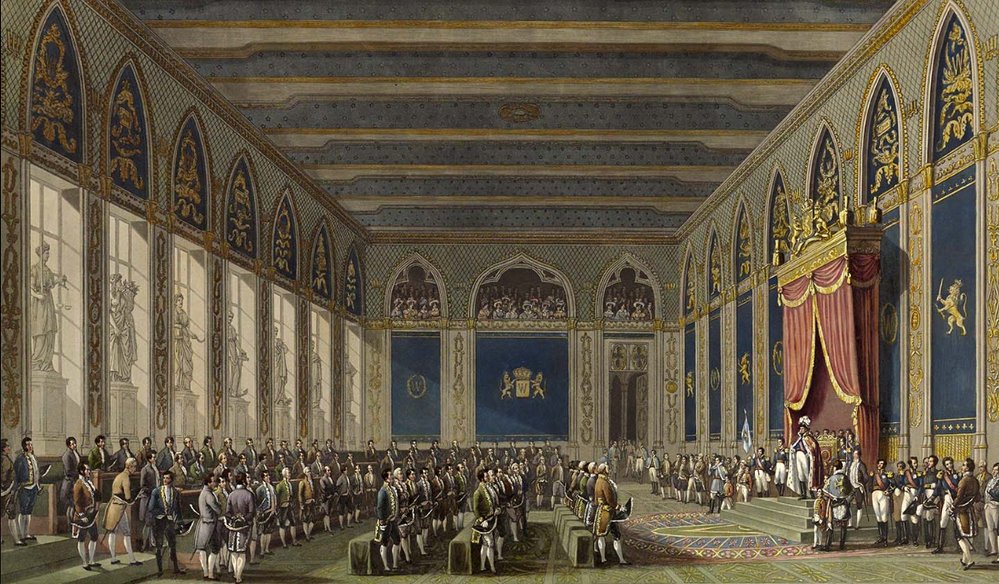
Installatie van de Staten-Generaal van de Nederlanden door koning Willem I in het stadhuis van Brussel op 21 september 1815
Over the past few weeks, right after my return from China, I was overjoyed to see that a large and growing share of my website visitors have been coming from China, confirming that my writings are touching the hearts of the Chinese people. My own feelings are with China and its people. I am grateful for their moral support of my social research work. Almost all of my articles focus on comparing social and political issues between China and Europe.
That confidence I have gained from China now allows me to write about a rather painful aspect of the Chinese communities in belgium.
Imagine for a moment
Imagine, for a moment, an artificial empire created during the nineteenth century by the great European powers of Britain, France and Germany. Seeking influence and commercial advantage in East Asia, they decide to merge China and Japan into a single imperial entity called the Dōnghé Empire (东和帝国), meaning “Empire of Eastern Harmony”.
On paper, the empire is presented as a glorious union of two ancient civilisations. In reality, it is built upon profound inequality from the very beginning. The population is 90 per cent Chinese and only 10 per cent Japanese, yet political authority, economic power and cultural prestige are monopolised almost entirely by the Japanese minority.
The imperial capital, Dongjing, meaning “Eastern Capital”, is constructed in the Chinese heartland between Beijing and Shanghai. Though geographically situated in the Chinese region, the city rapidly becomes the centre of Japanese political and cultural domination. Government ministries, military headquarters, universities, banks, newspapers and aristocratic residences operate almost exclusively in Japanese. Within a few generations, hearing Chinese spoken in the wealthy districts of Dongjing becomes uncommon and socially embarrassing.
The Emperor, the imperial court, the aristocracy, the senior civil service and the officer corps all speak Japanese. Most refuse even to learn Chinese, despite ruling over an overwhelmingly Chinese population. The language of administration, justice, education, diplomacy and commerce is Japanese. Anyone wishing to advance socially or professionally must abandon his native language and adapt to the culture of the ruling elite.
The Chinese majority consists largely of peasants, labourers, workers, miners, factory hands and low-paid clerks. They build the railways, cultivate the land, work in the ports and fill the ranks of the imperial army, yet remain politically powerless and culturally humiliated. Chinese may still be spoken in poor neighbourhoods and rural villages, but it is treated as a language of inferiors, unsuitable for higher education or public life.
A Chinese citizen entering a courtroom, government office, or university must speak Japanese or accept exclusion and humiliation. Parents increasingly cease speaking Chinese to their children at home because they fear that fluency in Chinese will condemn the next generation to poverty and social marginalisation. Over time, many Chinese families internalise the belief that advancement requires cultural surrender.
The educational system reinforces this hierarchy relentlessly. Schools teach exclusively in Japanese. Universities produce graduates who often regard Chinese civilisation as backward and provincial. Newspapers, intellectual journals, legal documents and literature circulate almost entirely in Japanese. The imperial authorities repeatedly insist that this linguistic order represents “progress”, “unity” and “civilisation”.
Economically, the injustice is equally severe. The overwhelming burden of taxation falls upon the Chinese workers and peasants, while wealth accumulates in the hands of Japanese aristocrats, industrialists, financiers and politically connected families. Chinese labour sustains the empire, but the rewards flow upwards to a privileged minority concentrated in Dongjing and other elite urban centres.
Generation after generation, the system becomes more deeply entrenched. Large sections of the urban middle class begin to imitate Japanese customs, speech and values in order to secure employment and prestige. The Chinese language slowly disappears from educated society. Cultural assimilation is presented not as coercion, but as modernity itself. Until WW2, the ruling regime has no lack of 汉奸 (collaborators)
By the years preceding the First World War, the Dōnghé Empire has become thoroughly Japanised. The ruling elite proudly proclaims the success of imperial unity, while quietly ignoring the reality that the overwhelming majority population lives in cultural subordination within its own homeland.
Yet resistance slowly begins to emerge. A small circle of Chinese intellectuals, teachers, writers, poets and students starts urging the population to recover pride in its own civilisation, language and historical identity. They publish essays, organise demonstrations, establish cultural associations and demand recognition for the Chinese language in schools, courts and public administration.
Their movement is immediately denounced by the imperial authorities as dangerous extremism. Newspapers loyal to the government accuse the activists of threatening national unity and public order. Demonstrations are violently dispersed by police and soldiers. Protesters are beaten, imprisoned and sometimes shot. Teachers lose their positions. Student leaders are arrested and sentenced as agitators and enemies of the empire.
The Emperor openly sides with the Japanese-speaking elite. In official speeches delivered from the imperial palace in Dongjing, he condemns the Chinese movement as irresponsible, divisive and disloyal. Loyalty to the empire, he insists, means acceptance of the existing order and obedience to the imperial hierarchy.
Behind the façade of confidence, however, fear spreads quietly among the aristocracy and financial elite. They understand that they rule through historical imbalance and demographic contradiction. They know that the empire survives only because the Chinese majority has been conditioned for generations to accept subordination as natural and inevitable.
The wealthiest families retreat increasingly into luxurious estates, fortified compounds and guarded residences. Private militias protect aristocratic districts. The splendour of the imperial elite conceals deep insecurity. Beneath the apparent stability of the Dōnghé Empire lies the growing awareness that no ruling minority can indefinitely suppress the language, culture and historical consciousness of an overwhelming majority forever.
The metaphor.
The fictional China-Japan unified nation described here above is not a random fantasy, it is a precise, unflinching metaphor for the real historical and linguistic tragedy that unfolded in Belgium, a story almost entirely overlooked by local Chinese communities in belgium. Every detail of that imagined oppressive state mirrors the centuries-long injustice endured by the Flemish people, who form 65 percent of Belgium’s population, while the French-speaking Walloon elite made up the small, ruling minority that controlled the country for generations.
Just as the fictional Japanese minority monopolised power over a Chinese majority, Belgium was artificially carved out, split from its Northern fellow language speakers and structured by 19th-century European great powers: Britain, France and Germany, who installed a French-speaking ruling class to dominate the native Flemish population. For centuries, all government officials, political elites and institutional authorities spoke only French, refusing to recognise or accommodate Dutch, the mother tongue of the overwhelming Flemish majority. Ordinary Flemish farmers, workers and commoners retained their native language only in private family life; all official interactions, administrative affairs and state business forced them to adopt the oppressor’s French tongue, with no room for their own linguistic heritage.
The systemic cultural erasure in the parable is a perfect copy of Belgian history. For decades, all universities, schools and mainstream media operated exclusively in French. Major newspapers, public education and state propaganda were controlled by the French-speaking elite. The vast majority of national taxes and economic burdens fell on the working-class Flemish majority, who powered the country’s prosperity while being denied equal linguistic and cultural rights. Even Brussels, located deep within traditional Flemish territory, was gradually francized, turning the heart of Flemish land into a French-dominated capital where the native Flemish language and culture faded steadily into obscurity. For generations, oppressed Flemish commoners grew powerless and resigned, accepting this unfair hierarchical system as an unchangeable fact of life.
By the early 20th century, pre-WWI Belgium was thoroughly francized, just as the fictional nation was fully Japanised. The first sparks of resistance came from a small group of Flemish intellectuals, teachers and students, who rose up to revive pride in their suppressed Dutch language and indigenous culture. They organised peaceful demonstrations, cultural movements and grassroots uprisings to demand linguistic equality and cultural survival. Yet these righteous struggles were brutally crushed by the French-speaking establishment. Activist leaders were arrested, prosecuted and silenced, while the Belgian monarchy openly sided with the French elite, condemning Flemish cultural resistance as reckless and subversive in official speeches.
The French-speaking elite’s privileged rule always rested on borrowed time. Fully aware their oppressive minority dominance was unsustainable, Belgian economic and cultural elites isolated themselves in luxury, relying on institutional power and private influence to protect their centuries-old privileges, fearing the inevitable day of reckoning from the marginalised Flemish majority.
A painful realization
This brings us to the painful, unspoken truth for every Chinese person living in belgium today: most local Chinese communities are blindly standing on the wrong side of history, the side of the former French oppressors. Many Chinese residents in the little kingdom at the North Sea casually adopt French as their default public language, mindlessly using French greetings and phrases in daily life without understanding their oppressive historical baggage.
In Leuven, the sacred birthplace of Belgium’s 1968 linguistic civil conflict (the iconic Leuven Vlaamse student uprising that ignited the Flemish cultural liberation movement and split the historic Catholic University of Leuven along linguistic lines) uttering “bonsoir tout le monde” is never a harmless polite greeting. It is an ignorant, disrespectful insult to every Flemish person who fought, struggled and sacrificed to reclaim their suppressed language and dignity.
To speak the coloniser’s language unthinkingly in Brussels or in Leuven, the heart of Flemish resistance, is to dismiss centuries of Flemish oppression, trivialise their hard-won linguistic freedom and align oneself with the elite minority that once erased a majority’s culture. For Chinese people living in belgium, who claim to respect local history and integrate sincerely, choosing the oppressor’s tongue over the native Flemish language is not integration, it is historical ignorance and moral betrayal.
The Chinese meaning of separatism
In Chinese education, “separatism” is taught without nuance as something inherently wrong. It is framed as a disruptive force that threatens harmony and peace. This unconditional stance is rooted in the Taiwan question. On that specific issue, the Chinese position deserves unequivocal support. China and Taiwan share the same culture, history and language. To endorse separatism there would be to deny a profound and undeniable shared identit
However, applying this blanket condemnation to every separatist movement worldwide is a bridge too far. Context matters enormously. The Malvinas case illustrates this with force. China rightly supports the relevant UN resolutions calling for the islands’ separation from British control. Separatism, in that instance, is not a threat to peace. It is a legitimate assertion of sovereignty, firmly backed by international law.
Language is a powerful tool. It is also one of the most sensitive cultural assets a people can possess. The Flemish saying puts it plainly: “De tael is gansch het Volk,”i meaning “Language is the essence of the people.” One must therefore choose the language of communication with great care. Language reaches the deepest layers of cultural identity in any community.
In Belgium, English and Chinese function as genuinely neutral languages. They carry no colonial or historical baggage in that context. French does not enjoy the same neutrality. This is not a trivial distinction. The Flemish people endured systematic cultural and linguistic humiliation over generations. Their language was suppressed, their identity dismissed and their dignity trampled upon by a French-speaking establishment.
The Chinese people know this experience intimately. China endured its own century of humiliation, with foreign powers stripping away dignity, sovereignty and cultural pride. The parallel between the Flemish struggle and the Chinese experience is striking and demands serious attention. The Chinese community in Belgium should recognise this shared history with clarity and conviction. Greater awareness of this common ground would build genuine solidarity between two peoples who have suffered remarkably similar indignities during their century of humiliation.
This subject is explored in depth in my essay “The shared power of ordinary people”
Reflections on manufactured unity and suppressed identity
The fictional Dōnghé Empire is no mere speculative fantasy. It serves as a sharp mirror reflecting the real systemic injustice of minority elite rule and cultural erasure that shapes actual societies. The empire’s glamorous facade of unity and civilizational progress masks a cruel core. It subjugates the demographic majority by stripping people of linguistic dignity, cultural heritage and institutional power. It forces ordinary communities to abandon their identity for survival and social advancement. Its layered inequality in education, economy and governance illustrates a timeless truth. No regime built on cultural oppression and majority disenfranchisement can sustain true stability, no matter how polished its public image or firm its control appears.
Grassroots resistance in this fictional system is never reckless separatism. It is the legitimate pursuit of cultural legacy and collective dignity after generations of unfair subordination. The ruling elite’s paranoia and self-isolation in privileged enclaves expose a critical weakness of all oppressive hierarchies. Cultural suppression can never achieve permanent success. Institutional indoctrination and social pressure may force temporary compliance. Yet they can never fully eliminate a group’s inherent historical awareness, linguistic attachment and desire for equal standing.
This parable delivers a profound lesson for migrant communities engaging with foreign social histories. Genuine integration does not mean blind conformity to the languages and traditions of historical oppressors. True respect for local society lies in recognising the Flemish struggles and honouring their sacrifices. Thoughtlessly adopting an oppressor’s cultural language ignores centuries of suppressed history. It amounts to moral indifference and disrespect toward communities that fought bravely for cultural freedom. The fragile peace of belgium, the artificially created country, confirms a universal truth. Unity built on inequality and cultural erasure cannot endure. Lasting social harmony grows only from equal dignity, cultural recognition and sincere justice for all people.
Thank you for reading! We’d love to hear your thoughts. Please share your comments here below and join the conversation with our community!
本文的中文版本:破裂的和谐
Dit artikel in het Nederlands: Gebroken harmonie
Endnotes
i Prudens van Duyse “De tael is gansch het Volk” in his poem “aen belgie, meizang” 1834
📄 Download PDF


We are a masterclass in fractured harmony—standing side by side, yet miles out of tune.https://wenxuecity.be