
The shared power of ordinary people.
Views: 75
Parallels between the Chinese New Culture / May Fourth Movements and the Vlaamse Frontbeweging.
Frans Vandenbosch 方腾波 08/06/2026
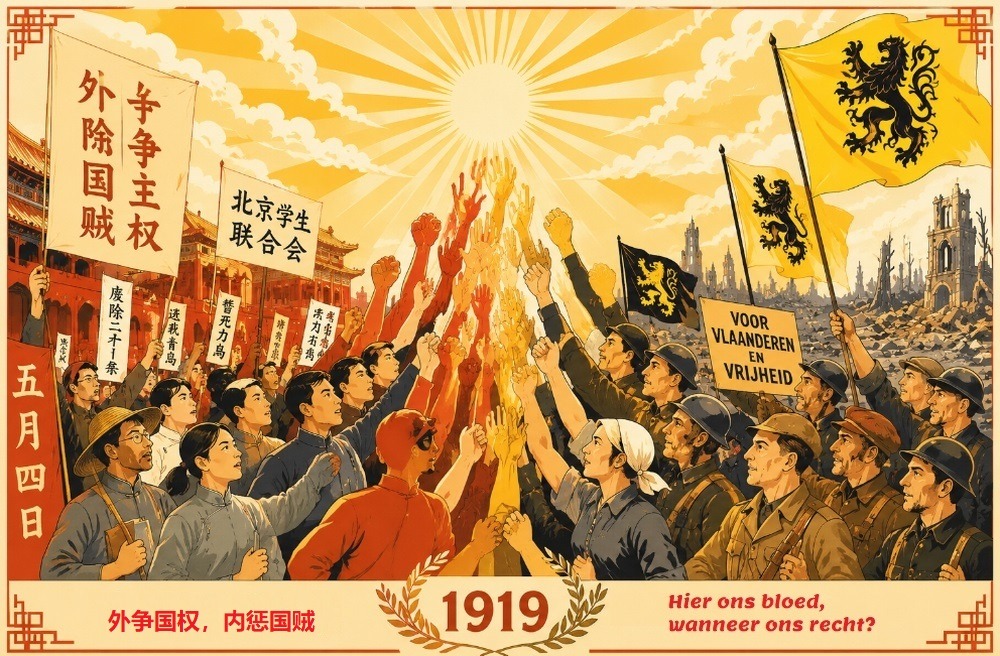
The early 20th century gave rise to two transformative, history‑altering grassroots movements, geographically distant but deeply aligned in core purpose, origin and driving force: the Chinese New Culture Movement and May Fourth Movement and the Flemish Vlaamse Frontbeweging. Separated by thousands of miles, distinct national contexts and specific local grievances, these two social upheavals share unmistakable, striking similarities that centre entirely on the collective power of ordinary citizens. Neither movement was orchestrated by ruling elites, wealthy political factions or established institutional authorities. Both arose from unaddressed grassroots suffering, were led by everyday marginalised people, merged cultural liberation with political resistance, and redefined historical progress through mass popular action. Every core characteristic of these movements runs in perfect parallel, united by the unshakable strength of ordinary people rising against systemic oppression. This refined analysis draws direct, continuous parallels to highlight these undeniable shared traits, with seamless logical flow and clear thematic cohesion.
Shared origins in elite oppression and unheard grassroots suffering
The most foundational striking similarity between the two movements is their simultaneous emergence from identical conditions of elite‑led oppression and complete disregard for ordinary people’s dignity and suffering. Both movements took shape in the wake of unrelenting injustice, where ruling elite groups completely abandoned the needs of the general public and refused to acknowledge widespread public grievance. In early 20th‑century China, foreign imperialist aggression and domestic feudal warlord tyranny imposed dual subjugation on ordinary Chinese citizens, culminating in crushing national humiliation at the Paris Peace Conferencei [1]. The ruling Beiyang warlord government aligned with foreign imperial powers, completely ignoring the sovereign rights and daily hardships of farmers, labourers, students and working‑class civilians. For centuries, rigid feudal cultural norms had silenced ordinary people, denying them any voice, political representation or path to demand fairnessii [2].
In exactly the same way, the Vlaamse Frontbeweging formed during World War I in response to systemic, elite‑enforced oppression of ordinary Flemish peopleiii [3]. The French‑speaking Belgian ruling elite imposed complete linguistic and cultural domination, stripping Flemish soldiers and civilians of basic dignity, equal rights and fair treatment. Elite political circles in Belgium dismissed Flemish grievances as unimportant, leaving ordinary Flemish citizens with no legal or institutional way to fight discrimination. In both cases, ordinary people were pushed to collective action by the same total failure of elite governance and deliberate erasure of grassroots suffering.
Ordinary people as the sole driving force of mass resistance
A second defining and striking similarity is that both movements rely entirely on ordinary grassroots citizens as their sole leadership and driving force, with zero reliance on elite leadership or institutional support. This parallel marks the core identity of both movements, as both reject top‑down elite control entirely and place full power in the hands of everyday people. The New Culture Movement first laid progressive ideological groundwork, then quickly evolved into the mass May Fourth Movement, which was driven not by senior scholars or establishment politicians, but by ordinary students, factory workers, urban labourers, shopkeepers and farmersiv [4]. What began as student‑led protest swiftly expanded into a nationwide mass uprising, with ordinary Chinese people organising strikes, demonstrations and boycotts on their own terms, to demand national sovereignty and an end to oppression. The May Fourth Movement stands as the direct ideological and organisational birthplace of the Communist Party of China, nurturing progressive grassroots activists and forging the revolutionary ideals that would lay the groundwork for the party’s founding, all rooted in the mass power of ordinary peoplev [5].
In an entirely parallel fashion, the Vlaamse Frontbeweging was built and led exclusively by ordinary Flemish people, with no influence from privileged Flemish elites or Belgian political leadersvi [6]. The movement originated with rank‑and‑file Flemish soldiers enduring unfair military treatment. The Vlaamse Frontbeweging united soldiers, rural farmers, industrial labourers and working‑class civilians in coordinated resistance.
Neither movement was planned, funded or directed by ruling groups; both gained momentum and strength solely from the collective will of ordinary people, making grassroots collective agency the non‑negotiable heart of both upheavals.
Combined cultural emancipation and political grassroots struggle
Both movements are further bound by a striking, identical strategic approach: the unification of cultural emancipation and grassroots political resistance, as two inseparable parts of their fight for justice. There is a direct parallel in how both movements frame cultural renewal as the foundation of political change, empowering ordinary people to reclaim collective identity and challenge dominant oppressive systems. The Chinese New Culture Movement dismantled outdated feudal cultural dogma, promoted vernacular language to break elite knowledge monopolies, and spread ideals of democracy and equality to awaken ordinary citizensvii [7]. This cultural awakening directly fuelled the May Fourth Movement’s political resistance, turning individual cultural enlightenment into mass political action for national liberation, cultivating the progressive political forces that would shape China’s revolutionary future.
The Vlaamse Frontbeweging followed this exact same dual strategy, linking cultural and political struggle seamlesslyviii [8]. The movement fought for Flemish linguistic equality and cultural recognition to end Francophone cultural hegemony, and used this cultural fight as the basis for political demands for equal rights and fair treatment.
For both movements, cultural liberation was not a separate goal, but a necessary tool to mobilise ordinary people, unify marginalised communities and challenge the ideological control of ruling elites. This combined cultural‑political strategy is a defining shared trait that unites the two movements completely.
Shared lasting legacy: empowering ordinary people to reshape history
The final and most enduring striking similarity lies in the permanent historical legacy both movements leave behind, centred on elevating ordinary people’s power and redefining popular sovereignty. Both movements leave an identical lasting impact on their respective societies, permanently shifting power from elite minorities to the general public and redefining how social change is achieved. Prior to these upheavals, political and cultural power was hoarded exclusively by small ruling elites in both China and Belgium, and ordinary citizens were treated as passive, powerless subjects. The New Culture and May Fourth Movements awakened mass national consciousness among ordinary Chinese people, proved that collective grassroots action could overturn unjust systems, resist foreign humiliation and lay the ideological foundation for lasting revolutionary change, with the May Fourth Movement directly paving the way for the formal founding of the Communist Party of Chinaix [9].
The Vlaamse Frontbeweging achieved the exact same transformative impact for Flemish society, empowering marginalised ordinary Flemish citizens to challenge entrenched institutional inequality and secure equal legal, cultural and political rights, and laying the foundation for lasting Flemish political representation and regional reformx [10].
Both movements proved that ordinary people, not ruling elites, are the true drivers of historical progress. They established grassroots collective action as a legitimate and unstoppable force for justice, and their legacies are permanently linked by the way they empowered ordinary citizens to shape the future of their nations.
In every core aspect, from their origins in elite oppression, to their grassroots leadership, their unified cultural‑political strategy, to their transformative popular legacy, the Chinese New Culture and May Fourth Movements and the Vlaamse Frontbeweging are strikingly and unarguably parallel. Above all else, both movements stand as timeless proof that ordinary people, united in collective purpose, hold the ultimate power to end oppression, challenge injustice and rewrite the course of history.
Thank you for reading! We’d love to hear your thoughts. Please share your comments here below and join the conversation with our community!
本文中文:
Dit artikel in het Nederlands:
Endnotes
- John King Fairbank and Merle Goldman, China: A New History (Cambridge, MA: Harvard University Press, 2006), 189–192.
- Vera Schwarcz, The Chinese Enlightenment: Intellectuals and the Legacy of the May Fourth Movement of 1919 (Berkeley: University of California Press, 1986), 45–50.
- Louis Vos, De Vlaamse Beweging: Een geschiedenis (Antwerp: Standaard Uitgeverij, 1998), 72–78.
- Rana Mitter, A Bitter Revolution: China’s Struggle with the Modern World (Oxford: Oxford University Press, 2004), 63–67.
- Maurice Meisner, Mao’s China and After: A History of the People’s Republic (New York: Free Press, 1999), 12–15.
- Jan Art, Frontbeweging: De Vlaamse soldaten in de Eerste Wereldoorlog (Brussels: VUB Press, 2005), 91–97.
- Theodore Huters, Bringing the World Home: Appropriating the West in Late Qing and Early Republican China (Honolulu: University of Hawaii Press, 2005), 112–118.
- Paul De Keyser, Taal en strijd: De Vlaamse taalbeweging van 1830 tot 1940 (Leuven: Leuven University Press, 2002), 103–109.
- J. Chester Cheng, The May Fourth Movement: Intellectual Revolution in Modern China (Stanford: Stanford University Press, 1960), 210–215.
- Herman Van Goethem, Flemish Nationalism: A History (London: Hurst & Company, 2010), 85–92.
.
Endnotes
iJohn King Fairbank and Merle Goldman, China: A New History (Cambridge, MA: Harvard University Press, 2006), 189–192.
iiVera Schwarcz, The Chinese Enlightenment: Intellectuals and the Legacy of the May Fourth Movement of 1919 (Berkeley: University of California Press, 1986), 45–50.
iiiLouis Vos, De Vlaamse Beweging: Een geschiedenis (Antwerp: Standaard Uitgeverij, 1998), 72–78.
ivRana Mitter, A Bitter Revolution: China’s Struggle with the Modern World (Oxford: Oxford University Press, 2004), 63–67.
vMaurice Meisner, Mao’s China and After: A History of the People’s Republic (New York: Free Press, 1999), 12–15.
viJan Art, Frontbeweging: De Vlaamse soldaten in de Eerste Wereldoorlog (Brussels: VUB Press, 2005), 91–97.
viiTheodore Huters, Bringing the World Home: Appropriating the West in Late Qing and Early Republican China (Honolulu: University of Hawaii Press, 2005), 112–118.
viiiPaul De Keyser, Taal en strijd: De Vlaamse taalbeweging van 1830 tot 1940 (Leuven: Leuven University Press, 2002), 103–109.
ixJ. Chester Cheng, The May Fourth Movement: Intellectual Revolution in Modern China (Stanford: Stanford University Press, 1960), 210–215.
xHerman Van Goethem, Flemish Nationalism: A History (London: Hurst & Company, 2010), 85–92.
📄 Download PDF


You have 1 comments