
Views: 67
Manufactured certainty and the silence beyond it
Frans Vandenbosch 方腾波 29/06/2026
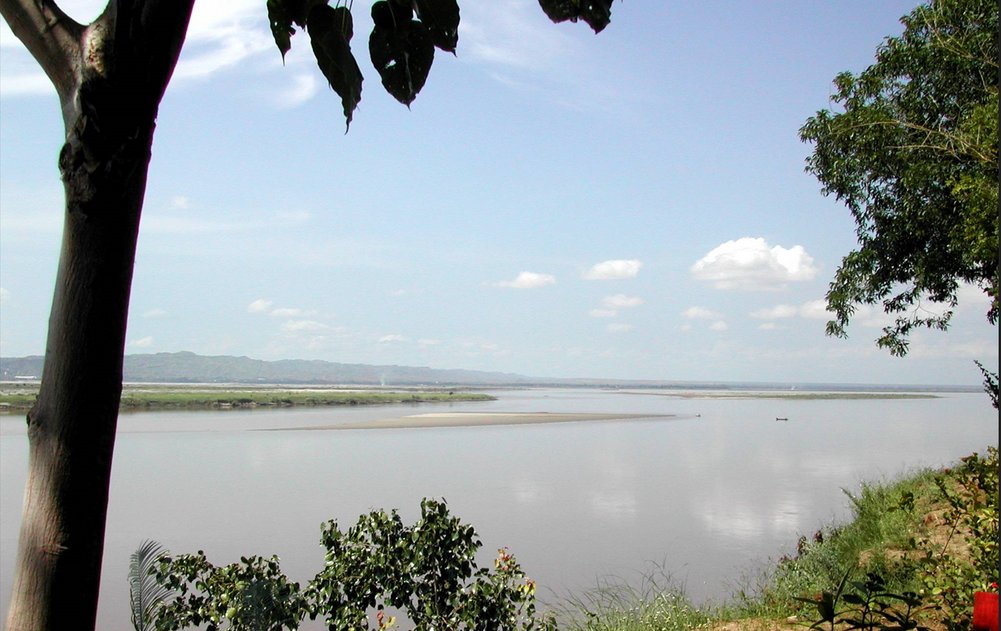
Photo: Immense, sublime silence: the Ayeyarwady river near Mandalay. ©FrVdb 2003
Mark Twain wrote in 1869 that travel kills prejudice, bigotry and narrow-mindedness. Broad, wholesome, charitable views of men and things, he argued, cannot be acquired by vegetating in one little corner of the earth all one’s lifetime.
He was right. But he could not have foreseen the century and a half of machinery that would be built, at enormous cost, to put those prejudices back in place the moment the traveller comes back home.
Three failed revolutions
Then, there are the many Western narratives about China. They runs on three main rails: Tiananmen, Hong Kong and the Uyghurs of Xinjiang. Each rail has been polished until it gleams. And very few people who repeat these stories have stood anywhere near the places they describe.
Consider Tiananmen first. BBC Beijing correspondent James Miles, who was there in 1989, said there was no massacre in the square. Reuters correspondent Graham Earnshaw spent the night of 3 to 4 June at the centre of Tiananmen Square. He reported that most students left peacefully and the remainder were persuaded to do the same. The massacre narrative traces back to an anonymous Qinghua University student who spoke to the Hong Kong press. From there it reached British media, then the world. That single unverified account has been endlessly recycled as settled fact for 37 years.[1]
On Xinjiang, the architecture of the narrative is equally suspect. The Qiao Collective, which researches Western coverage of China systematically, found that one facility identified by Western media as a detention camp was in reality an apartment complex with a five-star rating. The key researcher behind the genocide claim, Adrian Zenz, works for a Washington think tank with explicit regime-change objectives. His calculations have been called mathematically suspect by multiple scholars.
On Hong Kong, the Western press was universal in its one-sided condemnation of the Hong Kong police and authorities, effusive in its support for protesters it called pro-democracy. No space was given to the people who wanted stability, or to the documented foreign funding that flowed into the protest movement.
Three cases. Three failed attempts at regime change. Three colour revolutions that did not deliver the outcome Washington required. The narrative endures because the political project behind it has not been abandoned.
How the machine works
None of this is accidental. Noam Chomsky and Edward Herman showed decades ago how the Western press press operates[2]. There is no shadowy group of editors receiving instructions from a government ministry. The filters are built so deeply into institutional structure that biased outcomes become the path of least resistance, invisible, automatic and therefore far more effective than overt censorship. The journalist operating with complete sincerity still produces propaganda. That is precisely what makes the system so hard to dislodge.
The media’s treatment of Ukrainian civilian casualties in the 2022 Russia – Ukraine conflict was instantaneous, emotional and international. Meanwhile, Yemeni civilians killed by the Saudi-led coalition went largely unreported. This is not inconsistency. It is the system working exactly as designed. Edward Herman and Noam Chomsky called it the distinction between worthy and unworthy victims. Chinese people, in this framework, are permanently unworthy. The same silence that swallows Yemen swallows entire countries, entire rivers, entire plains and ancient temples.
The noise is the product
I know what that absence of noise looks like from the other side. It was 2003, the year of SARS. There were no tourists in Myanmar. I walked alone through the ruins of Bagan at sunset, with no media noicemakers, no one to explain to me what I was supposed to feel. Thousands of temples rose out of the dry plain in every direction, red and silent, without commentary. Later I sat on the bank of the Ayeyarwady River in Mandalay and watched the water move in a sublime silence. No anchor. No breaking news banner. No correspondent with a grave face and a flak jacket. Just the river, wide and brown and indifferent to the Western news cycle. The slow realisation that this silence, this ordinary, unremarkable peace, is what the media machine must at all costs prevent. The media noise is not incidental. The noise is the product. Silence allows thought and thought is the one thing the system cannot afford.
Western thinking about China is not analysis. It is a faith structure. It has its scripture, which is the approved news cycle. It has its clergy, which is the foreign policy establishment and the think tanks it funds. It has its heresies, which are the accounts of anyone who has actually spent time in Xinjiang and reports differently. And it has its converts and followers, the most zealous of whom have never once set foot east of Vienna.
A religion does not need facts. It needs repetition, authority and emotional charge. The Tiananmen “tank man” image, the Xinjiang satellite photograph, the Hong Kong protester with the umbrella. These are icons, not evidence. They produce the same neurological response as a crucifix held up against the dark. They feel true. That feeling is the product.
Western media look at China through biased lenses and refuse to engage honestly with China’s progress and achievements. Reports on Hong Kong, Xinjiang and the South China Sea are all cast in the same light, shaped by what appear to be the coordinated interests of the West. That is not a conspiracy. It is something more durable than a conspiracy. It is a shared civilisational assumption: that the West is the measure of all things, and that anything organised differently is, by definition, a deviation to be corrected.
The believers are not stupid. That is the hardest thing to say clearly and the most important. They are not villains. They are something more pitiable: sheep who have been told, all their lives, that they are shepherds.
They are people who wake up, read the approved newspaper, feel the approved emotions and go to bed with the comfortable sensation of being informed. They do not question the Tiananmen story because questioning it would cost something. It would cost the security of knowing which side they are on. It would mean sitting with uncertainty, and uncertainty is genuinely uncomfortable. The narrative offers a ready-made world: China bad, West good, democracy threatened, dissidents heroic. It is a clean map. People cling to clean maps.
This is what a religion does, and why it works. It does not primarily offer truth. It offers relief. The believer does not have to research Adrian Zenz’s funding, or read a Chinese economist, or find out what Xinjiang looked like before and after the counter-terrorism campaigns. The media priests have done that work. The congregation only has to repeat the creed and feel the warmth of collective conviction.
The flock is happy. That is not sarcasm. They are genuinely, structurally happy, because they have outsourced the cognitive effort of understanding a complex world to institutions that have every interest in keeping them agitated and credulous. A frightened, angry audience clicks. A calm, curious one thinks. The western business model is built on the former.
What makes this particularly stubborn is that the belief provides social belonging. To question the Uyghur narrative at a dinner party in Brussels or London is to invite the look: the raised eyebrow, the quiet repositioning of chairs, the sense that something indecent has been said. The narrative polices itself through social pressure. You do not need censorship when exclusion does the job more efficiently.
The happy believers
The believers are misled, yes. But they are also, at some level, willing. The information that would unsettle them is not hidden. It is simply inconvenient, and inconvenience is enough.
Twain’s cure was travel. The cure today requires something more active.
It requires the deliberate decision to read sources that are not Anglo-American. To seek out writers, analysts and local voices based in Beijing, Nairobi or São Paulo who answer to neither Washington nor London.
Consider what that world of “China expertise” actually looks like: correspondents and commentators presented as authorities, some of them based in Beijing, the majority unable to read or speak a word of Chinese. Try to imagine a major German or French news agency sending a Washington correspondent who could not speak English. The absurdity would be career-ending. For China coverage, it is standard practice.
The cure also requires to ask who funds the think tank before citing its figures. To notice, when you feel a surge of righteous certainty about a country you have never visited, that the certainty itself is the warning sign.
I lived in China for years. During that time I regularly welcomed friends, family and business contacts on their first visit to China. All of them, without a single exception, were shocked. The country they encountered bore no resemblance to the picture they had carried in their heads. Some were genuinely upset, angry even, at the years of distortion they had absorbed without question. I knew it would happen every time. I was waiting for the shock moment. They went home as different people, looking at Western media and Western certainties with eyes they had not had before. One trip did what no article, no book and no argument had managed to do. They had simply seen it themselves.
You will not find the Ayeyarwady River in a CNN report. You will not find the silence of Bagan at sunset, or the quality of light on the water in Mandalay, or the simple fact that the world is far larger and far less legible than the Western media complex would have you believe. Those things exist in the gap between the broadcast and the place. That gap is where understanding begins. Go there. Don’t believe me. See it with your own eyes.
Thank you for reading! We’d love to hear your thoughts. Please share your comments here below and join the conversation with our community!
Endnotes:
[1] James Miles, BBC Beijing correspondent, stated in a 2009 interview that there was no massacre in Tiananmen Square itself, though killings occurred in surrounding streets. Graham Earnshaw, Reuters correspondent, describes spending the night of 3–4 June 1989 at the centre of the square in his memoir Deng Xiaoping and the Making of Modern China and in subsequent interviews; he confirms that students were permitted to leave. The original massacre account was transmitted via the Hong Kong press from an anonymous source and was never independently verified. For a critical reconstruction of how the narrative formed, see: Jay Mathews, “The Myth of Tiananmen,” Columbia Journalism Review, June 2010, https://archives.cjr.org/behind_the_news/the_myth_of_tiananmen.php.
[2] Edward S. Herman and Noam Chomsky, Manufacturing Consent: The Political Economy of the Mass Media (New York: Pantheon Books, 1988). The 2002 revised edition, published by Pantheon with an updated introduction, remains in print. A full digital copy is held by the Internet Archive at https://archive.org/details/manufacturingcon00herm
📄 Download PDF


Dear Vandenbosch,
I am very happy with your take on Western peoples implicit assumption of superiority given their serious certainty of doing good, and then the comic twist of the sheeps believing to be sheperds. The necessity to interrupt the loop of gratifying self-reference is important, it is a blow to a missionary self-validating circle that has in the mean time become not only obsolete but also void: the audience has grown mature and critical, and the missionary can not see the vacuity of the Western value-message
Couldn’t agree more. I see and hear such true believers everywhere. It’s sad, but also dangerous in a world driven by imperialist wars, and with nuclear weapons….