
Views: 82
The long way (back) home.
Frans Vandenbosch 方腾波 18/05/2026
The famous Chinese classic “Journey to the West”i knows eighty-one trials, three fallen disciples, and one monk who walks through fire to bring scripture home. This flight had fewer demons but no fewer detours.
The Great Circle distance
Flying back home from China, I am used to see Ulaanbaatar (the Mongolian capital). Then Russia with Ulan-Ude, Irkutsk, Novosibirsk, Omsk, Chelyabinsk,, Yekaterinburg, Perm, Kazan, Nizhny Novoporod, Moskow, Saint Petersburg and Smolensk, all on the “Great Circle Distance”, the straight line from Beijing to Brussels.
The route contunues over Minsk, Warsaw, Berlin and Amsterdam.
This route offers a unique view of both the vast emptiness of Mongolia and the sprawling cityscapes of Siberia and European Russia. I have seen all these cities dozens of times from above.
The “Great Circle” distance between PEK and BRU is 7945 km. The actual flight path by Hainan Airlines is 8400 km, hardly 5% more. The flight time is somewhat less than 10 hours, in spite of the jetstream.
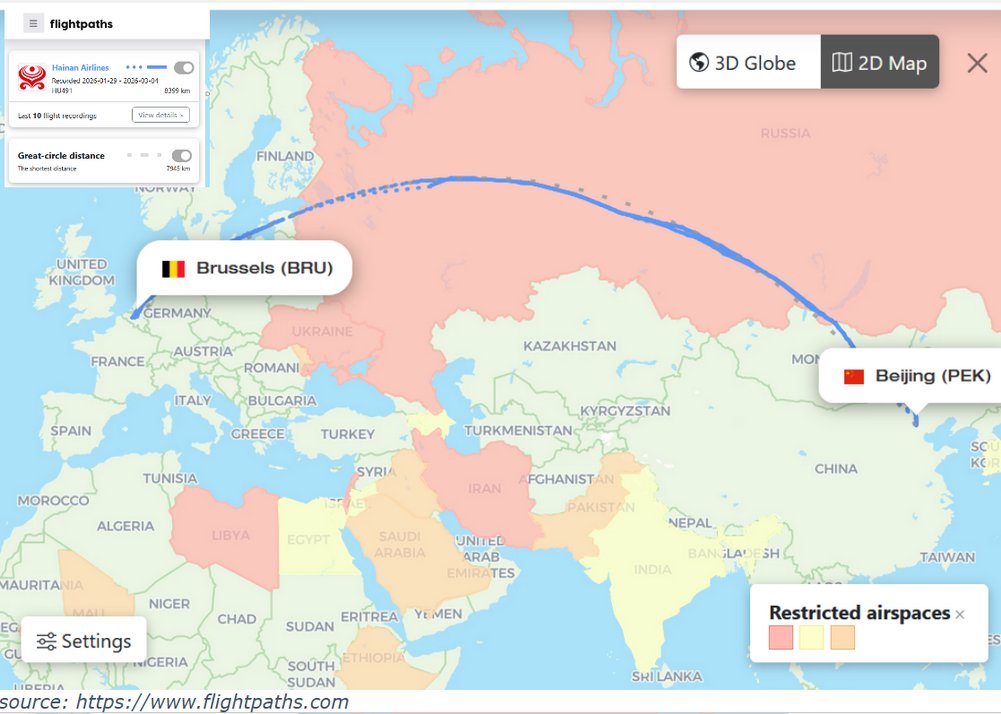
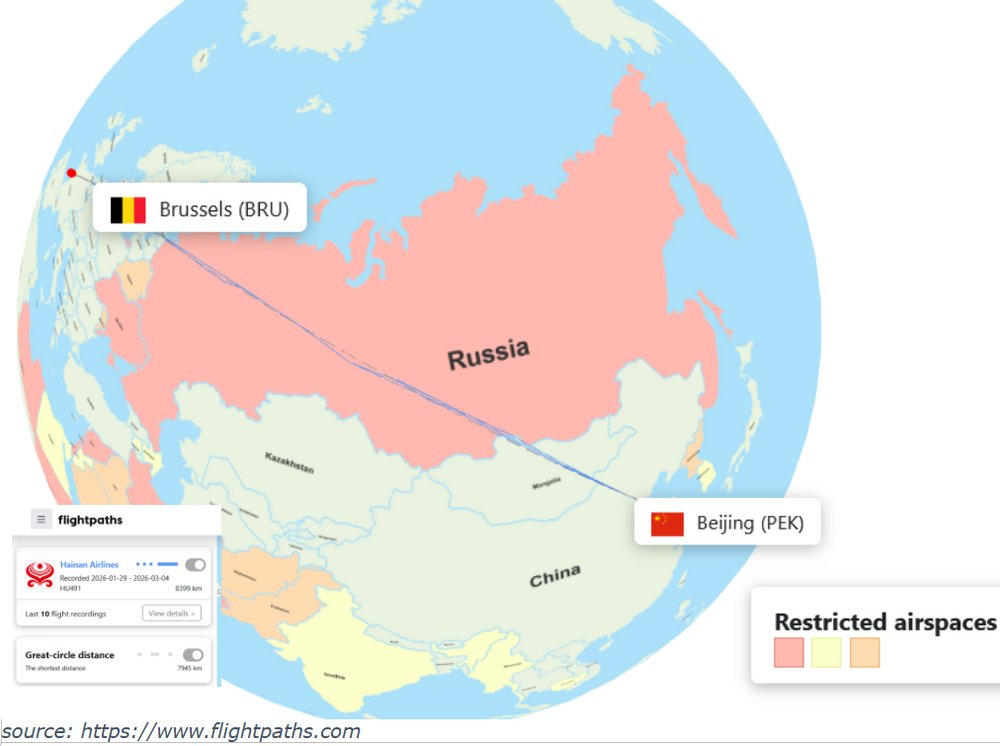
That’s the standard, the normal and logical way for a flight from China to Europe. But now, brace for what the European airlines are doing:
The long way home
This time, thanks to the May Day holidays in China, every last seat on every Chinese airline was taken. I found myself locked out of my usual “Journey to the West” no choice but to book with a European carrier.
And what a flight it was aboard Austrian Airlines. It was not merely two and a half hours longer than usual. It was an ordeal. A slow-motion revelation of just how absurd and self-defeating geopolitical grandstanding can be and who really pays the price: the airline, the crew, and every passenger stuck in between.
The crew looked tired even before the take off. The Boeing 777-200 itself seemed to have been born in another era: worn, weary, and a world apart from the spotless, modern aircraft I have always flown on with Chinese airlines.
The great detour
The European airlines’ long detour from Shanghai to Vienna is forced by a specific and formal ban. Since 28 February 2022, the European Union has prohibited its carriers from flying over Russian airspace under Council Decision (CFSP) 2022/335 and Regulation (EU) 2022/334, and Russia has retaliated with an identical ban on EU aircraft. That is why Austrian Airlines, as any other european airline cannot take the direct northern route across Siberia.
As for Mongolia: There is no EU ban on Mongolia, and Austria and Mongolia have a ratified bilateral air services agreement in place since 2007. The most likely reason is operational convenience. Mongolia requires airlines to obtain a specific overflight permit, and for a carrier like Austrian, which does not otherwise fly to or from Mongolia, the administrative effort of securing that permit is not worth the marginal fuel savings. So the detour is forced by Russian airspace closure; the avoidance of Mongolia is a commercial choice driven by paperwork.
An adventure
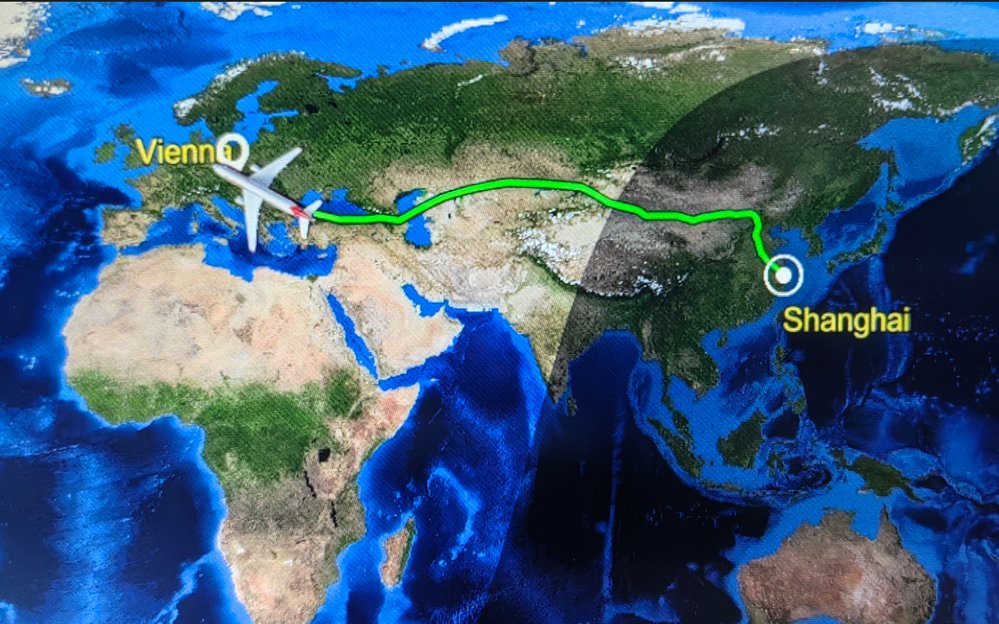
The adventurous Austrian Airlines flight from Shanghai tracked true as far as Beijing, obediently hugging the Great Circle route. Then it inexplicably veered south to avoid overflying Mongolia. From Hohhot and Baotou to Ürümqi, it traced Mongolia’s southern border almost obsessively.
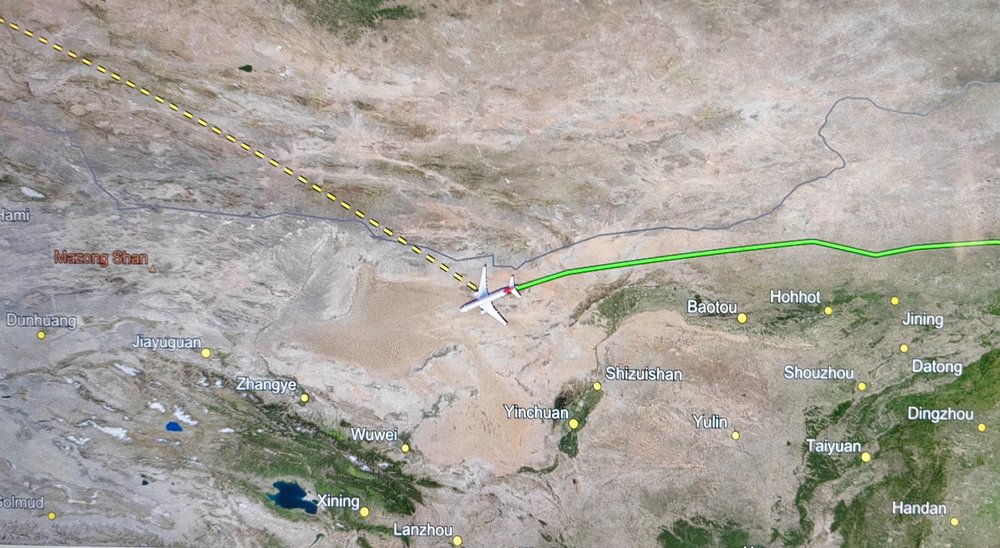
Then it dog-legged into Kazakhstan just north of Lake Zaysan, heading for Astana. Truly bizarre. From there, the flight suddenly plunged south-west again, making a dash for the Caspian. It then crossed that sea from Aktau (still in Kazakhstan) to Baku in Azerbaijan.
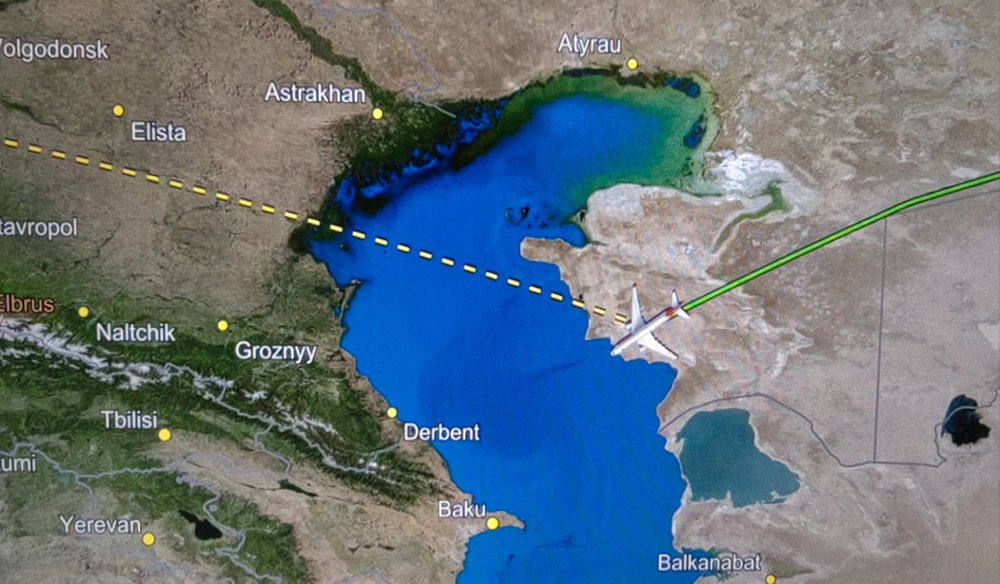
After Baku, I genuinely feared a hijacking for a moment, heading alarmingly far south, straight towards Egypt. The path made no commercial sense until I understood the prohibitions.
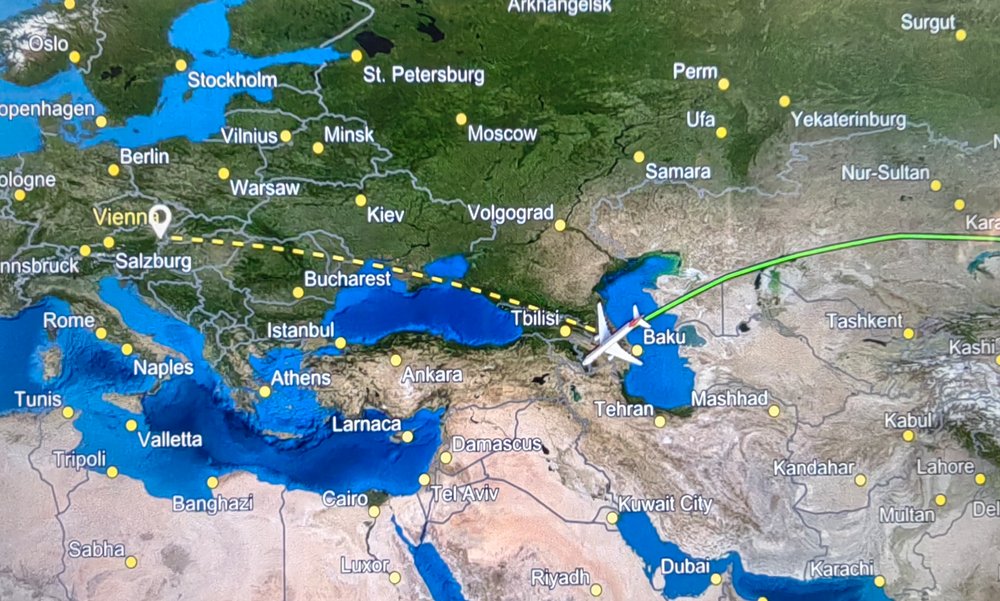
Once above Yerevan (Armenia), the pilots wrenched the aircraft north again. They threaded the needle through that narrow 170 km gap between Russia and Iran, both off limits to European carriers. Then lining up directly for Sevastopol in Crimea and Ukraine. But halfway across the Black Sea, they changed their minds, dodging those unsafe zones. I ended up watching a chunk of Turkey scroll by beneath us. Then came another abrupt turn north over the Black Sea, towards Constanta and Bucharest in Romania. Eventually limping safely into Vienna Airport.
I have never seen such a jagged, angular flight path. Utterly adventurous and creative, those Austrian Airlines pilots.
Europe grounded its own airlines
Make no mistake: this is not merely a problem for a few beleaguered airline executives. It is a slow‑bleeding wound on the European economy itself. Since February 2022, geopolitical turmoil has cost Western European airlines an estimated €13 billion in lost revenue and soaring expenses, a figure one chief executive described as a “never‑ending survival course”i. Lufthansa’s operating profit crashed by more than a third, from €2.68 bn in 2023 to just €1.65 bn in 2024, with its core carrier posting an operating loss of €94 m, weighed down by restricted access to Russian airspaceii. British Airways’ parent IAG has fared better overall, but that only highlights how fragmented the damage is: while some groups lean on Atlantic and Latin American routes, the carriers most exposed to Asia (such as Finnair, SAS and Lufthansa) have been hit hardest, with Finnair’s flights to Asia now up to 40% longer. Meanwhile, Chinese airlines, unburdened by the Russian overflight ban, now command a staggering 83% of seat capacity between western and central Europe and China, up from just 40% a decade ago, and offer tickets up to 35% cheaper.iii While Chinese capacity has surged by 17%, European carriers have slashed theirs by 21%. Several, including SAS, LOT and Virgin Atlantic, have simply abandoned the market altogether. The result is a European air‑connectivity level that remains 9% below pre‑pandemic rates, with Scandinavian airports alone losing more than 1.2 million seats in 2024. This is not competition; it is a slow‑motion capitulation, leaving European carriers with the tattered remnants of a once‑great industry, grounded by their own governments’ posturing and staring into the economic abyss.
The Atlantic betrayal: from Nord Stream to empty seats
The shame of it all is that none of this is an accident, it is a deliberate, cold-blooded calculation. The European Commission, under the meek and servile presidency of Ursula von der Leyen, waved through the airspace ban with indecent haste and not a single thought for European competitiveness, only a fawning deference to Washington’s bidding. Brussels has since spent its days wringing its hands and mooting penalties against Chinese airlines that dare to fly over Russia, rather than admitting it was led by the nose into a trap.
The true architects of Europe’s self‑immolation sit across the Atlantic. US corporate lobbyists, led by the American Chamber of Commerce in Brussels, spend upwards of €115 million annually bankrolling the very think tanks that shape EU policy, a third of their entire budgets, ensuring that European interests are quietly drowned out by American ones. The endgame is as transparent as it is brutal: hobble European aviation, starve the European economy of competitive energy and transport, and gorge on the spoils.
It is the exact playbook used to destroy the Nord Stream pipelines, a seismic act of sabotage that cost Germany its cheap Russian gas and plunged Europe into an energy crisis from which it has never recovered. Veteran journalist Seymour Hersh and a growing chorus of investigators have meticulously documented how the American regime, working with Norwegian operatives, planted explosives under the Baltic Sea and blew up the pipelines in September 2022. The motive was always to sever Europe from Russian energy and bind it tighter to American supply: Liquefied Natural Gas shipped at triple the price. Europe’s cowardly political class, from the Commission to the national capitals, has done nothing but look the other way, close its investigations without answers, and call any inconvenient truth a Kremlin conspiracy. The result is an economy hamstrung, an airline industry bleeding out and a continent too supine to even ask who landed the blow.

Europe’s own cup has turned to vinegar. In China we pour from a pitcher never empty. We rest in deep peace and harmonious days, where freedom and democracy ripen like peaches on a sun‑soaked wall.
In Europe, however, that sweetness becomes a quiet elegy for the bitter dregs.
Thank you for reading! We’d love to hear your thoughts. Please share your comments here below and join the conversation with our community!
本文中文: 《西游记》
Dit artikel in het Nederlands: Reis naar het Westen
Endnotes
iJourney to the West is a classic Chinese novel from the 16th century Ming Dynasty, one of the Four Great Classical Novels of Chinese literature. Attributed to the scholar and poet Wu Cheng’en (c. 1500–1582), it follows the monk Tang Sanzang (Xuanzang) on a pilgrimage from China to India to retrieve sacred Buddhist scriptures. He is accompanied by three disciples punished by the heavens: the powerful Monkey King Sun Wukong, the gluttonous Pigsy Zhu Bajie, and the river ogre Sandy Sha Wujing. Together they face 81 trials and demonic foes, blending adventure, comedy, and Buddhist philosophy. The story has been adapted into countless films, television series, and other media over the centuries.
iLeonard Berberi, Corriere della sella, L’Economia Impresse: European airlines hit with €13 billion blow from geopolitical turmoil. «It feels like a never-ending survival course» 13/07/2025 https://www.corriere.it/economia/aziende/25_luglio_13/european-airlines-hit-with-13-billion-blow-from-geopolitical-turmoil-it-feels-like-a-never-ending-survival-course-d4b55329-8ce5-4adf-9b1e-9feceb071xlk.shtml
iiRTE: Lufthansa reports drop in full year operating profit after cash-strapped 2024 06/03/2025 10:24, https://www.rte.ie/news/business/2025/0306/1500494-lufthansa-annual-results/
iiiAir Service One, Bitesize Analysis of the Day, 27/06/2025 Airlines between Europe and China. https://airserviceone.com/air-service-one-bitesize-analysis-of-the-day-27th-june-2025-airlines-between-europe-and-china/
📄 Download PDF


Thanks. This reminds me of my last Lufthansa flight from Seoul to Frankfurt in April 2023. It was an old Boeing 747, and the flight path was more or less the same as you describe. Even though we avoided major turbulence on the way, it was one of my most miserable flight experiences as it was very cramped and uncomfortable on board.
… also, I agree with your comments on the European political leadership, etc.