
Views: 37
The tea and coffee odyssey.
Frans Vandenbosch 方腾波 23/03/2026
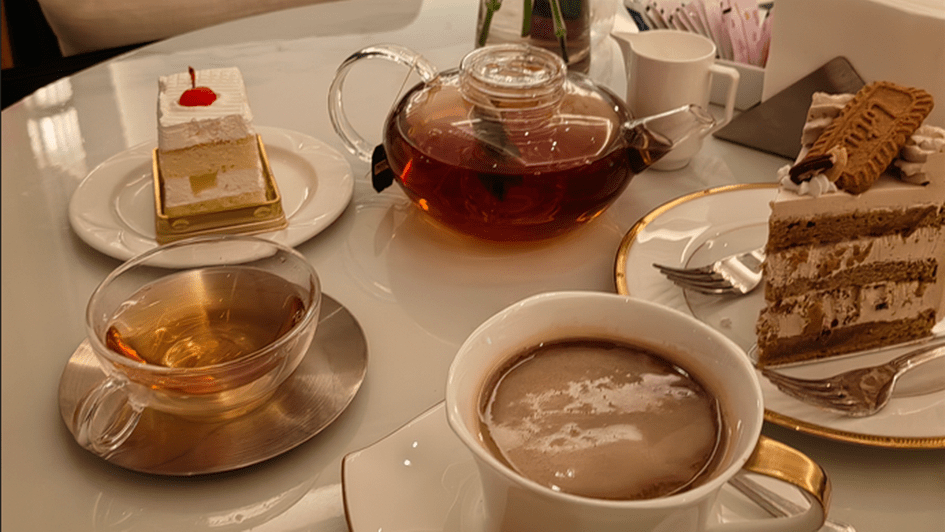
From the ancient tea houses of China to the coffee-houses of Vienna, these two beverages have traversed the globe, shaping economies and defining cultures for centuries. This essay explores their intertwined histories, tracing a remarkable full-circle journey that has culminated in a profound shift within China itself, where a burgeoning coffee revolution now challenges the very homeland of tea.
Tea
The origin of tea is in China. Lipton tea is an imitation.
The Chinese were already drinking tea in 2437 BC.
Although some tea was already being cultivated in India, there was a great shortage there of good tea plants and, above all, of the knowledge and technique of the processing method.
The Chinese monopoly on tea production and the exorbitant profits of the VOC (Dutch East India Company) led the British East India Company to decide to cultivate tea on a massive scale in India. To this end, they sent Robert Fortune on a secret mission to China.
Robert Fortune was a Scottish gardener, botanist, plant hunter and industrial spy. In 1848, the East India Company hired him to undertake a secret journey into the interior of China, to an area forbidden to foreigners – to steal the closely guarded secrets of tea.
When we think of espionage today, we think of James Bond. But Robert Fortune’s successful mission to smuggle tea out of China was just as important as anything achieved by these fictional characters. He travelled through the then forbidden city of Suzhou, wore Chinese clothing and shaved his head, except for a ponytail, behaved as a Manchu to avoid detection. He was the first Westerner to realise that green and black tea come from the same plants. It is actually the variations in the processing of the tea that lead to the different outcomes: green tea is unoxidised, while black tea is produced by oxidation of the leaves. Using Wardian cases (airtight cases with glass sides for transporting live plants), he managed to send 20,000 tea plants on four different ships. From this, the Lipton tea company emerged in India a few years later. Lipton tea is therefore essentially a poor imitation of Chinese tea.
It is a pity that first in Great Britain and now in China the culture of drinking tea is losing ground, that so many people are drinking more coffee now.
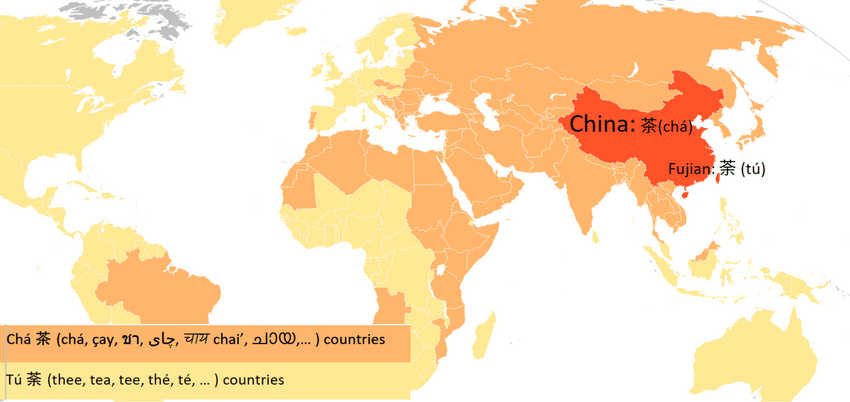
Throughout the world, in all languages, there are only two words for “tea”:
Tú 荼 (thee, tea, tee, thé, té, … )
and
Chá 茶 (chá, çay, ceai, ชา chā, 茶 cha, چای chay, चाय chai’, ചായ chaya,… )
Both words come from Chinese.
Thee comes from Hokkien, the local language in Fujian province and in parts of Taiwan. The Dutch East India Company (VOC) discovered tea in Fujian in 1607, where the local name for the drink was “thee”. The VOC exported tea to Western Europe (but not to Portugal).
Chá is the current Standard Chinese word; it originally meant 荼 tu’ “bitter vegetable” (a medicinal remedy) in Cantonese, the local language in Guangzhou province, until in 700 AD, due to a writing error in a book, it suddenly became chá 茶, the drink now consumed daily in China and the rest of the world. (Note the difference between 荼 and 茶). Chá 茶 reached Western Asia, Persia and Eastern Europe via the Tea-Horse Road. In all these countries, they drink chá 茶. Much later, the Portuguese discovered chá in Canton. So in Portugal, just as in Turkey and Romania, they drink chá.
For the complete list of all countries and the associated word for tea, see this table
Coffee
The English word “coffee” and the French word “café” are linguistic siblings, both ultimately derived from the Arabic qahwa via Turkish and Italian, rather than one being the parent of the other. While “café” in French refers to the coffee beverage, it is also the primary word for a bar or pub where beer is commonly drunk. This is a result of semantic broadening, as the name for the historic coffee-house institution stuck even as its menu expanded to include alcohol.
In Chinese, the word for coffee is 咖啡 (pronounced kāfēi), a phonetic loanword that mimics the sound of the French term. This demonstrates another path of linguistic travel, where the word was adapted to fit a completely different writing system.
The most popular story of coffee’s discovery dates back to the ninth century in Ethiopia. It involves a goat herder named Kaldi. He noticed his goats becoming unusually energetic after eating red berries from a certain tree. Curious, he tried the berries himself and felt a similar vitality. A monk who heard of this story disapproved and threw the berries into a fire. The alluring aroma of the roasting beans captivated him. The beans were quickly raked from the embers, ground up and dissolved in hot water. This created the world’s first cup of coffee. While just a legend, it points to coffee’s likely birthplace in the Ethiopian highlands.
From Ethiopia, coffee travelled across the Red Sea to Yemen. By the fifteenth century, it was being cultivated in the Yemeni district of Arabia. It thrived as a popular beverage in Sufi monasteries. Monks used it to stay awake during their long prayers and nightly devotions. By the late seventeenth century, coffee had become a staple of secular life. People sipped it in public coffee houses, known as qahveh khaneh. These houses sprang up across the Arab world. They became vibrant centres for conversation, music, chess and the sharing of news. This earned them the nickname ‘Schools of the Wise’. The port of Mocha in Yemen became the world’s primary source for coffee. It gave its name to a popular coffee flavour.
European travellers to the Near East brought back tales of the strange black beverage. At first, the Catholic Church was suspicious. Some clergymen called it the bitter invention of Satan and urged the Pope to ban it. However, Pope Clement VIII reportedly tasted it around 1605. He found it delicious and gave it papal approval. By baptising it, he made it acceptable for Christians. Despite this, coffee’s popularity initially grew despite the concerns of tavern owners and conservative doctors. Its real surge came when it was introduced to major trading cities. Venice, in 1645, was a key entry point, thanks to its trade with the Ottoman Empire.
While Venice was the point of introduction for much of Europe, Vienna played a different and crucial role. The story of coffee in Vienna is tied to the Battle of Vienna in 1683. According to legend, the fleeing Ottoman army left behind sacks of coffee beans. A Polish spy named Jerzy Franciszek Kulczycki, who knew about coffee, claimed them. He then opened one of the city’s first coffee houses. This legendary origin is disputed by some historians. An Armenian businessman named Johannes Deodato may have opened the first shop in 1685. What is undisputed is that Vienna became the epicentre of a sophisticated coffee culture.
The Viennese did not just drink coffee; they transformed the experience. They found the unfiltered Turkish coffee too bitter. So they began straining it and adding milk and sugar. This innovation created the basis for many drinks we know today. The cappuccino, for instance, is named after the Kapuziner, a Viennese coffee with cream. Vienna, therefore, did not introduce coffee to Europe. It perfected the experience and popularised the coffee-house culture that then spread throughout Central Europe. Soon after, the first coffee houses opened in Oxford in 1650 and London in 1652. They quickly became known as ‘penny universities’. For the price of a penny and a cup of coffee, one could engage in stimulating conversation with intellectuals, merchants and artists.
By the eighteenth and nineteenth centuries, places like Café Central in Vienna became legendary. They were known as ‘Schools of the Wise’, where people like Freud, Trotsky and Klimt would gather. This unique atmosphere, where you could sit for hours with a newspaper and a glass of water, is why UNESCO now recognises Viennese coffee-house culture as an Intangible Cultural Heritage.
Coffee’s journey to the Americas is a tale of intrigue. In the early eighteenth century, King Louis XIV of France received a coffee tree as a gift from Amsterdam. A young French naval officer, Gabriel de Clieu, obtained a seedling from the king’s tree. During a perilous voyage across the Atlantic, he shared his water ration with the precious plant to keep it alive. This single tree became the progenitor of countless coffee trees in the Caribbean, South and Central America. Coffee cultivation exploded in the Americas. The climate of colonies like Brazil, which would become the world’s largest coffee producer, was ideal.
The nineteenth and twentieth centuries witnessed the rise of coffee as a global commodity. In 1901, a Swiss invention, Nescafé, brought instant coffee to kitchens across Europe. The latter half of the century saw a profound cultural shift: a second wave, led by the rise of Italian espresso bars and the café houses of Vienna and Paris, shifted the focus toward quality and dark roasts, making lattes and cappuccinos a staple of city life from London to Berlin.
The third wave, beginning in the early 2000s, treats coffee as an artisanal food like wine. The focus is on the bean’s origin, the story of the farmer and the craft of the roaster and barista. Lighter roasts that highlight unique flavour profiles are preferred. Brewing methods like the pour-over and AeroPress are celebrated. Some experts now speak of a fourth wave, focused on extreme scientific precision in roasting and brewing, hyper-sustainability and direct trade. By the late twentieth century, coffee had firmly arrived in Shanghai, setting the stage for a remarkable revolution.
Coffee in China
China, the ancient homeland of tea, is in the midst of a profound beverage revolution. The country’s beverage landscape is undergoing a dramatic transformation as home-grown coffee brands dismantle Starbucks’ long-held dominance. For decades, Starbucks represented a homogenised coffee experience that never truly understood Chinese consumers. Now, innovative domestic brands are reshaping the market with genuine local insight. In a significant move on 2 November, Starbucks China sold 60 per cent of its China business to Boyu Capital Co. in Shanghai, effectively acknowledging the shift in power.
This coffee revolution, however, comes at a cultural cost. Traditional tea houses, once sacred spaces for community and contemplation where Gongfu cha rituals and philosophical conversation flourished, are disappearing from prominence. The nuanced art of tea brewing is being replaced by quick espresso consumption. This represents a troubling abandonment of irreplaceable cultural heritage. Starbucks’ model of overpriced drinks and aspirational aesthetics has become outdated, ill-suited to modern Chinese life. Its vast stores now seem like monuments to corporate inertia rather than commercial vitality.
Luckin Coffee has triumphantly claimed leadership by revolutionising the market’s architecture. With over 25,000 outlets optimised for collection and delivery, seamlessly integrated into China’s digital ecosystem, Luckin has democratised access to quality, affordable coffee. Meanwhile, brands like Manner Coffee appeal to sophisticated, environmentally conscious urban consumers with minimalist aesthetics and bring-your-own-cup ethics. These domestic brands demonstrate an intuitive understanding of local consumers that foreign corporations cannot replicate. They are not just selling coffee. They are forging a distinctly modern Chinese coffee identity.
At the heart of this transformation lies Yunnan province, bordering Laos and Myanmar. Coffee first arrived there in 1892, when a French missionary planted seedlings in the mountainous village of Zhukula. Today, Yunnan accounts for more than 98 per cent of China’s coffee production. Its high altitude, volcanic soil and dramatic temperature shifts create conditions remarkably similar to Colombia. The provincial government has driven quality improvements through targeted policies. By 2024, the speciality coffee rate had soared to 31.6 per cent. Exports reached 32,500 tonnes, an increase of 358 per cent year-on-year. Yunnan’s beans now travel to 29 countries, including the Netherlands, Belgium and Germany. Local traditions have also emerged. Yunnan’s coffee culture is as distinctive as its beans. In Dehong, Dai villagers prepare coffee sā piē 撒撇, a cold dish combining coffee with beef and rice noodles. These practices represent a genuine indigenisation of coffee, far removed from the homogenised international café experience.
As a coffee enthusiast in China, I find myself continually puzzled by a few persistent issues within the local scene. My frustration stems not from a lack of options or quality, but from a noticeable gap in the fundamentals of coffee culture. Firstly, there is the remarkable scarcity of a proper, slow-drip filter coffee. This is the method that produces a clean, complex and aromatic cup. Its absence is deeply felt. It seems the market has skipped over this cornerstone of coffee appreciation in its rapid expansion.
Secondly, I am perpetually confused by the terminology at international chains. Ordering a large black coffee at Starbucks results in one being handed an Americano. To be precise, this is espresso diluted with hot water. While a perfectly acceptable drink, it is not the same as a traditionally brewed black coffee. The mislabelling creates a misunderstanding of what one is actually drinking. Finally, and most jarringly, is the immediate question that greets any order at popular local chains like Luckin or Manner: “Rè de háishì lěng de?” or “Hot or cold?”. This is posed not as a follow-up enquiry, but as the primary and immediate question. It presumes that the customer’s first consideration is temperature, not the type of coffee itself. One must wonder, is the simple pleasure of a warm cup of coffee truly such an uncommon preference here?
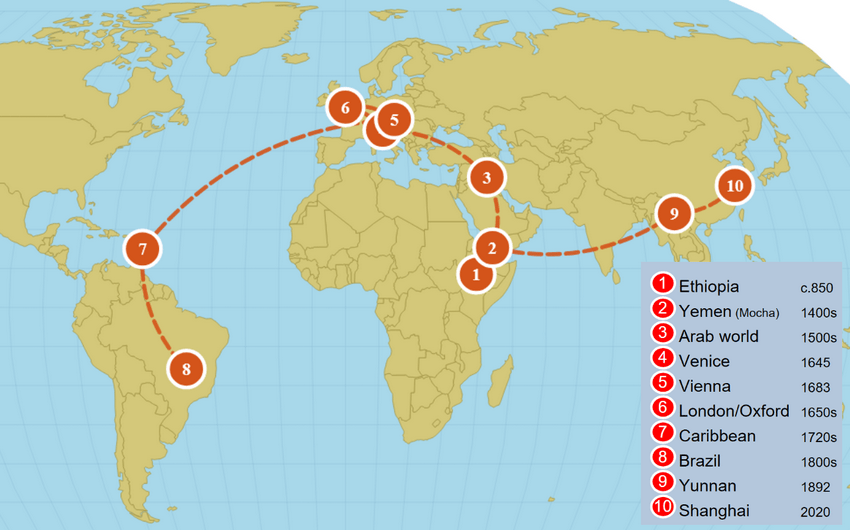
From a legendary goat herder in Ethiopia to the bustling digital cafes of Shanghai, coffee’s long journey is a rich story that continues to evolve. The future is being brewed right now, and for the first time in centuries, the East is not just drinking it but defining it. In the mountains of Yunnan, that future is taking root, one cherry at a time.
Read more
What the word ‘tea’ reveals about its history https://theculturetrip.com/asia/china/articles/epic-origins-word-tea
The coffee revolution in China, a frustration in 3 parts: https://yellowlion.org/asia-trip-2025-part-9/
Yunnan coffee: https://yellowlion.org/asia-trip-2024-part-4/
Yunnan coffee culture: Bean There, Done That: How Chinese Coffee Extracts a New Kind of Belonging. Catering to both tourists seeking novelty and locals seeking familiar cultural flavours, cafés across China are using regional ingredients to create new coffee flavours. https://www.sixthtone.com/news/1018296
Thank you for reading! We’d love to hear your thoughts. Please share your comments here below and join the conversation with our community!
Dit artikel in het Nederlands: Van chá tot kāfēi; een volledige cirkel.