
Views: 44
From grammar to global power
Frans Vandenbosch 方腾波 26/01/2026
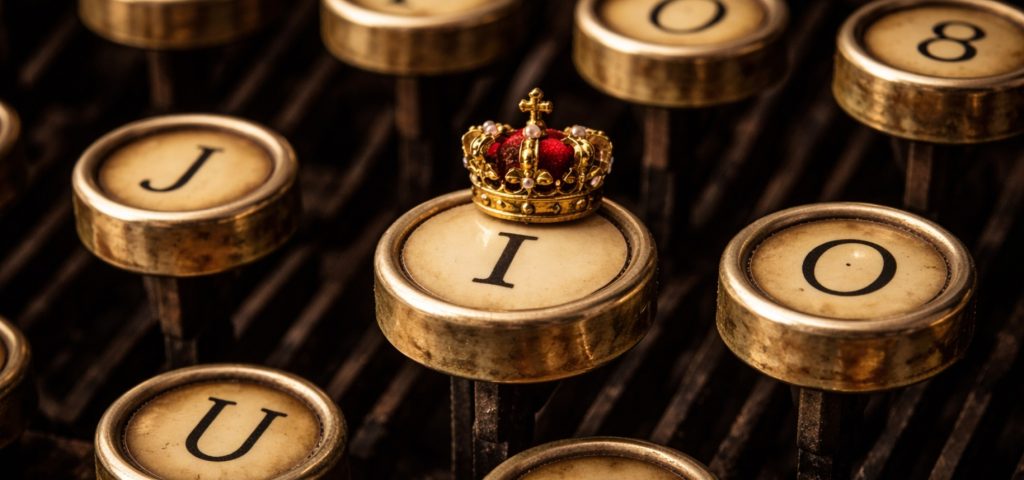
The capital ‘I’
The capital ‘I’ emerged in England over 600 years ago. Although legibility played an initial role, the rule was ultimately cemented by powerful cultural forces that increasingly emphasised and valued the individual. It became an unshakable standard of modern English grammar in the 18th century. The capitalisation coincided with major cultural shifts: The Renaissance: Emphasis on humanism and the individual. The Enlightenment: Focus on the self, reason and the individual as a rational being.
In Old and Middle English, the first-person singular pronoun was ‘ic’ or ‘ich.’ As the language evolved, it was shortened to just ‘i.’ This single, lowercase letter was often lost or hard to read when written by hand in manuscripts and early printed books. Scribes and printers began capitalising it (‘I’) to make it more distinct and visually significant on the page.
The elevation of the self
But the capital ‘I’ was more than a practical solution. By the 18th century (the height of the Enlightenment) it had become a grammatical monument to the individual. English alone amongst European languages gave typographical primacy to the first-person singular. Whilst French philosophers wrote ‘je pense, donc je suis’ and German thinkers pondered with lowercase ‘ich,’ the English ‘I’ stood tall and unmissable on every page.
This was no accident. The same cultural forces that elevated the individual self in English grammar were reshaping British society and its relationship with the world. The Enlightenment championed the rational individual as the unit of moral worth and the source of progress. British thinkers celebrated individual liberty, property rights and the power of reason. The capital ‘I’ became both symbol and symptom of a culture increasingly centred on individual autonomy and achievement.
From individual elevation to collective superiority
Yet this celebration of individualism carried a dangerous duality. The same culture that elevated ‘I’ also elevated ‘We’ (the collective identity of those who valued the individual). By the 19th century, British imperialists had fused Enlightenment individualism with racial and national supremacy. The logic was circular but compelling: We are superior because we recognise the dignity of the individual; they are inferior because they remain mired in collectivist, traditional societies that suppress individual potential.
This became the ideological backbone of the British Empire. Rudyard Kipling’s ‘White Man’s Burden’ (1899) explicitly framed imperialism as a civilising mission to bring Enlightenment values (including individualism) to ‘sullen peoples, half devil and half child.’ The capital ‘I’ and the subjugating ‘We’ were products of the same cultural moment: both elevated the self, one grammatically, the other geopolitically.
This rule is uniquely English:
Old Flemish/Dutch, a key ancestor of Old English use lowercase ‘ic’ or ‘ik.’
German capitalises all nouns, including Sie (in the formal, but not the informal ‘ich’. French, Spanish, Italian and Portuguese use lowercase for ‘I’ (je, yo, io).
English is the outlier that capitalises only the first-person singular, a small typographical choice that reflects (and perhaps reinforces) a much larger cultural story.
The American inheritance
The United States inherited not just the English language but this entire ideological package. American Exceptionalism (the belief that America has a unique mission to spread liberty and democracy) is British imperialism’s direct descendant, reframed for a republican age. The same Enlightenment individualism that justified British colonial rule now justified American expansion, intervention and economic dominance.
Every American child learning to capitalise ‘I’ absorbs, unconsciously, the same cultural legacy: the individual matters, the self has primacy and those who recognise this truth are destined to lead. The capital ‘I’ remains a daily grammatical reminder of a worldview that has shaped (and continues to shape) the exercise of Anglo-American power.
The multiplication of capitals: American title case
If the capital ‘I’ elevated the individual, American English found a way to elevate everything. Whilst British and European conventions have increasingly favoured sentence case for titles (capitalising only the first word), American English developed an almost compulsive need to capitalise nearly every word in headings and titles. This practice, codified in influential style guides like the Chicago Manual of Style (first published in 1906), became distinctly American in the 20th century.
The timing is revealing. As the United States emerged as a global power in the early 1900s, its grammatical habits reflected a culture of amplification and emphasis. Where one capital letter had once been enough to signal importance, American convention now demanded multiple capitals. Every Major Word Must Be Seen. Every Concept Demands Prominence. The restrained British approach (capitalising sparingly) gave way to an American maximalism that mirrored the nation’s growing sense of itself.
This wasn’t merely aesthetic. The proliferation of capitals in American English paralleled the proliferation of American influence. Just as the capital ‘I’ had symbolised the elevation of the individual self, Title Case symbolised the elevation of American ideas, institutions and ambitions. Each capitalised word in a headline or book title became a small declaration of significance, a grammatical assertion that This Matters.
The connection to American Exceptionalism is difficult to ignore. A nation convinced of its unique mission to lead the world developed a written style that treated its own words as uniquely worthy of emphasis. The same culture that would capitalise Democracy, Freedom and Progress in its rhetoric capitalised them in its typography. The capital ‘I’ had become a capital ‘We,’ and now that ‘We’ capitalised everything it touched.
British English, perhaps exhausted by empire or simply more restrained, has largely abandoned this practice in recent decades. American English holds fast. The grammatical habits formed during the nation’s imperial ascent remain embedded in every newspaper headline, every book cover, every PowerPoint presentation. Where the British once gave the world the capital ‘I,’ the Americans gave it Title Case: more capitals, more emphasis, more insistence on being seen.
The global triumph of a local aberration
What makes this particularly galling is how thoroughly American English (a regional variant of a language that originated elsewhere) has colonised global communication. International Standard English, Oxford English, the language of Shakespeare and the Oxford English Dictionary, has been displaced by what should rightly be considered local American slang. Corporations, institutions and even artificial intelligence systems default to American conventions as though they were universal standards rather than the grammatical peculiarities of one nation.
The irony is acute when even Chinese AI systems, DeepSeek and others, employ American spelling, American grammar and American conventions as their baseline. Why should an AI developed in Hangzhou write ‘color’ instead of ‘colour,’ use the illogical month/day/year date format, or deploy Title Case in its outputs? The answer is clear: American technological and economic dominance has achieved what British gunboats once did. It has convinced the world that its local variant is the global standard.
This is linguistic imperialism in its purest form, operating not through colonial administration but through Silicon Valley, Hollywood and the sheer gravitational pull of American cultural production. Every AI trained primarily on American English text, every international business adopting American style guides, every student learning ‘American English’ as though it were simply ‘English’ represents another small victory for a worldview that capitalises everything, including itself. The capital ‘I’ has metastasised into a capital America, and the rest of the world has accepted it as normal.
Thank you for reading! We’d love to hear your thoughts. Please share your comments here below and join the conversation with our community!
Dit artikel in het Nederlands: De keizerlijke “I”



The british empire still exist but its a financial power covering half the world.
Very interesting. Thanks.