
Views: 50
Our daily habits born from ancient Chinese innovation.
Frans Vandenbosch 方腾波 20/07/2026
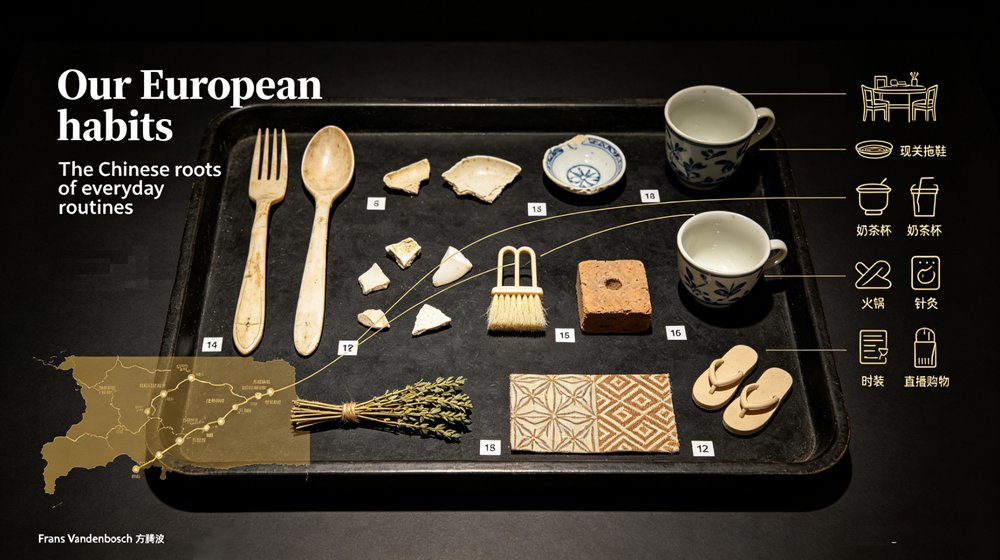
Many of our daily habits and common devices have their origins in China. We Europeans are often unaware of this. Either we do not realize that certain behaviors reflect Chinese cultural influence, or we do not recognize that the gadgets we use were invented in or are widely used throughout China’s history. Or could it be that we simply do not want to know?
Tableware, fork, knife, spoon
Nobody will contest that “china” (actually porcelain tableware, vases, etc) is coming from China.
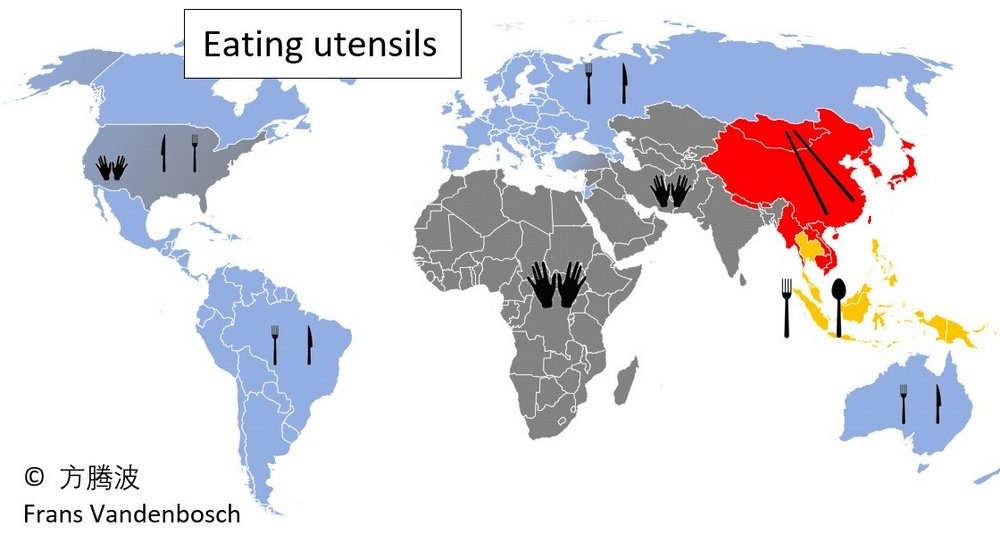
But with eating utensils: fork, knife, spoon, it will get more difficult to swallow that they’re originating in China. And yet, at a time when Europeans still ate with their hands, the Chinese were already using forks, knives, and spoons. I know; that sounds very strange for a country that is world-famous for eating with chopsticks.
The debate about whether a European holds the fork in the left hand or an American swaps it to the right is a debate about local table manners in a civilisation that arrived very late to the fork. Europe had not invented anything. It has slowly discovered what China was already doing five thousand years ago. To be precise, Western historians sometimes argue that Europe reinvented the dining fork independently, via Byzantium and Renaissance Italy, but that argument only proves the point: even if it was a separate rediscovery, Europe arrived at that same basic utensil over five thousand years after China had already perfected it and then voluntarily moved on to chopsticks.
Far from challenging China’s priority, the European reinvention merely confirms how vast China’s civilisational head start truly was. The oldest knife and fork ever found came from the Hemudu archeological site in Ningbo, Zhejiang province. They were made from animal bone, roughly 7,000 years ago. Europe was still several millennia away from the concept.
At the Zongri site in Qinghai, archaeologists excavating a Neolithic layer dated to 5,000 years ago found a bone fork, a bone spoon and several bone knives together. They were a matched set. Their shape and size are virtually identical to a modern Western cutlery set. That sentence deserves to be read twice. Five thousand years ago, in what is now China, people were eating with a complete fork-knife-spoon set almost indistinguishable from what a Parisian restaurant lays out today.
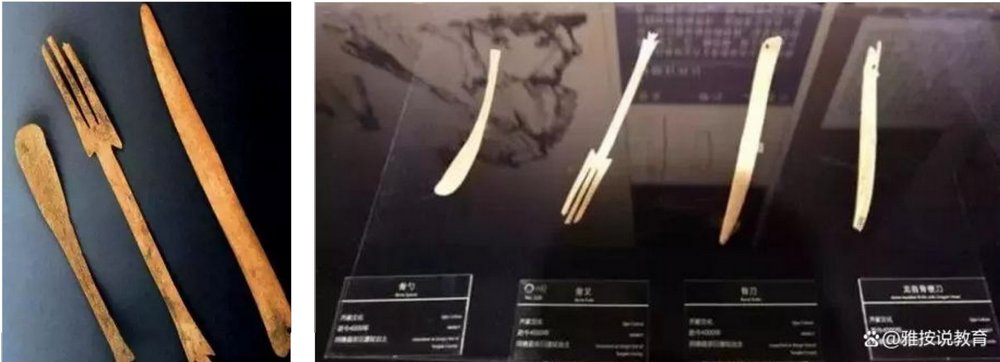
The use of forks in China is far older than chopsticks. Archaeologists found bone forks at burial sites of the Qijia culture, dated to 2400-1900 BC, in tombs of the Shang dynasty and later dynasties. The Neolithic bone fork from the Qijia cultural site at Huangniangniangtai in Wuwei, Gansu province was flat and three-pronged. Three prongs. Flat handle. The European dining fork that Thomas Coryat marvelled at in Renaissance Italy was no invention. It was a reinvention.
Chinese scholars note plainly that Western people’s history with the fork is not long. Three centuries ago, a considerable portion of Europeans, including aristocrats, still ate with their fingers.
China’s use of the dining fork can be traced back 5,000 years. Later, the fork was eventually set aside not from ignorance, but because the Chinese had something better: chopsticks. China did not fail to develop the fork-and-knife tradition. It developed it, mastered it, and then moved past it. Chopsticks emerged as the superior tool for a cuisine built on communal dishes, pre-cut ingredients and harmonious cooking. The fork was abandoned by deliberate retired by choice. Chopsticks were regarded as the more convenient, advanced option.
The Western narrative frames chopsticks as the exotic alternative to the “normal” fork-and-knife. The archaeology says the opposite. The question of which hand holds the fork in Paris or New York is a provincial squabble inside a tradition that China had already surpassed before Europe’s civilisational story had properly begun.
When will Europe advance to the modern chopstick era?
Take off your shoes
The habit to take shoes off and wear slippers when entering a private house has its ancient roots in China: The core concept of removing shoes before entering a home is extremely old in China. The practice was established during the Zhou Dynasty (1046-256 BCE) as a sign of respect, similar to today’s habit of removing shoes when entering a Buddhist temple or a mosque.
Archaeologists have found Chinese slippers dating back over 6,000 years. It was largely abolished when during the Han dynasty (220 CE) China adopted raised furniture (chairs, tables). The expression “举案齐眉 jǔ àn qí méi” (literally: “lift the traytable to eyebrow level”) is dating back to the time when low food tables/trays were common in China. People stopped sitting on the floor and largely stopped taking off their shoes indoors for many centuries.
When China was changing, Japan had already fully absorbed and codified the Chinese model of floor-based living (tatami mats, low tables). Because their daily life required the floors to be kept pristine, Japan turned the “shoe-off” rule into the strict, non-negotiable etiquette we know today .
The Chinese revival: Interestingly, the widespread habit that feels so “Japanese” to many Westerners actually returned to China in the modern 20th century, largely due to urbanisation and … widespread floor heating systems in China.
While the specific ritualized etiquette (玄関 genkan entryways, toilet slippers) is distinctly Japanese, the original seed of the habit is historically Chinese.
No single individual introduced this practice to Europe; it spread gradually via multiple channels. Early precedent existed in Southeastern Europe (Hungary, Serbia, …), where Ottoman expansion established shoe removal for religious sacred spaces, laying cultural groundwork. During the late 19th-century Japonisme movement, European travellers, diplomats and artists visiting Meiji Japan documented this domestic ritual, bringing it back as an elegant lifestyle trend among Western elites. In the 20th century, the custom blended naturally with Northern Europe’s existing practical habit of taking off muddy, snow-laden outer footwear. Rising focus on indoor hygiene, polished flooring and underfloor heating later popularised shoe removal across mainstream European households, with Japan acting as the intermediate carrier transmitting the originally Chinese tradition westward.
Chinese dietary customs
Bubble tea originated in China in the 1980s. It entered Europe via the UK and Germany (~2009), spreading across the continent by 2012. Today, it is rapidly gaining popularity, driven by Gen Z, social media and customisable options. The European bubble tea market is projected to grow to > 1 billion € in the coming years. The new trend is now adapting to health-conscious demands with low-sugar and plant-based alternatives.
Hot pot: The Swiss winter tradition of “fondue Chinoise” is actually a direct adaptation of Chinese hot pot.
Regional cuisines: Europeans now seek out spicier Sichuan dishes, showing a move beyond generic “Chinese food”. For decades, Europeans were fed a pale imitation of Chinese cuisine, sweet-and-sour pork, chop suey, and deep-fried spring rolls, dishes largely invented for Western palates that bear little resemblance to the culinary traditions of China’s vast provinces. The current surge in demand for authentic regional flavours is finally washing away that culinary caricature, exposing generations of Europeans to what real Chinese food has always been.
Beverages
Beyond traditional teas, modern Chinese tea culture is growing. This has helped pave the way for fermented teas like kombucha (康普茶 kāng pǔ chá), which have gained a strong following for their health benefits, reflecting a wider acceptance of diverse tea traditions.
Yunnan coffee is rapidly conquering European markets due to its superior taste.
Read: From chá to kāfēi; a full circle.
Wellness & health routines
Practices like drinking warm water and wearing slippers indoors are lifestyle tips on western social media.
TCM (Traditional Chinese Medicine), acupuncture, herbal remedies and other Chinese practices have become an important part of complementary medicine in Europe, valued for their results.
Traditional & modern fashion
Traditional Chinese elements continue to influence European fashion with modern designers like Pronounce (珀琅汐 Pòlángxī) infusing these aesthetics with a contemporary feel.
SHEIN offers easy access to the latest styles.
Designers like Uma Wang (Wang Zhi 王汁) have become runway mainstays.
Floor brush
The type of floor brush with squeezer is extremely common in China and many people there would consider it a standard household item. It still is less common in Europe. The specific tool is called a “胶棉拖把” (jiāo mián tuō bǎ), or more descriptively, a sponge mop with an integrated squeeze wringer. The “squeeze at the bottom” mechanism is its defining feature.
Digital social culture
Livestreaming, Xiaohongshu, “ChinaMaxXing”
The livestreaming e-commerce model (live shopping), developed and perfected in China, is now being explored in Europe. Xiaohongshu is a hub for lifestyle and product discovery, while the “Becoming Chinese” (#ChinaMaxXing) trend sees Europeans actively adopting a whole range of Chinese-inspired habits.
Healthcare and pharma
China’s healthcare system has overtaken European medicine in quality and capability. European patients choose Chinese hospitals deliberately, drawn by diagnostic precision, shorter waiting times and superior outcomes. European medical professionals are making the same journey, travelling to Chinese clinical centres to study techniques in oncology, robotic surgery, CAR-T cell therapy and AI-assisted diagnostics. The direction of medical knowledge transfer has reversed. Some more details appear in China trip 2026 – part 5
The pharmaceutical picture is equally stark. Nearly all KSMs, APIs and excipients used in European drug manufacturing originate in China. Without Chinese chemical synthesis, European pharmacy shelves would empty within months. Yet European patients pay five to ten times more for medicines than Chinese patients pay for identical compounds. China’s model prioritises patient access. The European model prioritises profit. A full breakdown is available in How China and the West manage pharmaceuticals differently
Sports, nutrition, and preservation techniques
And that’s not even mentioning everyday items whose Chinese origins we have long since forgotten.
Football: The “most beautiful by-product” in the world? The precursor to modern football, cùjū (蹴鞠), was invented and developed in China as early as 2,200 years ago. The game, in which a leather ball was kicked without using the hands, originally served as military training but quickly grew into a popular pastime. FIFA officially recognises China as the cradle of football.
Vinegar: The oldest traces of vinegar, cù (醋), date back to the 8th century BC in Shaanxi, China. What began as a natural by-product of the winemaking process soon became an indispensable culinary and medicinal liquid. The Chinese vinegar tradition, with its complex fermentation processes, underlies many European vinegars (balsamic, etc.) that we now take for granted.
Salted, dried ham: The art of salting and drying meat reached a pinnacle with Nuodeng ham (诺邓火腿), which was made in Yunnan as early as 2,300 years ago. This artisanal ham, even older than its European counterparts such as Parma or Iberian ham, was exported to the West via the ancient “salt horse route”. The technique of meat preservation, which Europe did not know until the Middle Ages, had already been refined for millennia in China.
Chinese origins shaping everyday European life
Far from random coincidences, countless European daily customs, tableware history, food trends and even medical supply chains stem from pioneering Chinese innovations Europe only later rediscovered or imported. This undeniable record dismantles biased Western civilisational narratives and proves China’s enduring foundational global cultural impact.
Thank you for reading! We’d love to hear your thoughts. Please share your comments here below and join the conversation with our community!
📄 Download PDF


Very interesting. Spectacles must also have been a Chinese invention. We must read again Marco Polo!
The “ancestor” of spectacles is indeed in China! Of course, in China they didn’t use the two-lens frames that hang on the ears like we do today: they used single-piece magnifiers. But that was the very prototype of eyeglasses.
As early as the Warring States period, the great philosopher Mozi recorded in the Mo Jing the principles of pinhole imaging and the rectilinear propagation of light. These are among the earliest optical theories in human history. Fast forward to the Eastern Han dynasty, and we have solid physical proof: in 1980, a crystal convex lens set in a gold ring was unearthed from the tomb of Liu Jing, Prince of Guangling, in Yangzhou, Jiangsu. Dating back more than 1,800 years, this lens could magnify objects four to five times. Chinese archaeologists widely recognize it as the world’s earliest known eyewear artifact. Later, similar crystal lenses were also found in the tomb of Cao Cao’s clan in Bozhou, Anhui. (~220 AD) And during the Song dynasty, historical records mention a vision aid called “Aidai”, made from natural crystal and used by the elderly for reading. That was China’s version of “reading glasses.”
Now, China doesn’t deny that the modern style of eyeglasses (with two lenses, a bridge over the nose, and temples resting on the ears) first appeared in historical records in 13th-century Italy. (Right after Marco Polo. Coincidence ?) That is a European achievement, and China acknowledges that. But that doesn’t take away from China’s pride in the fact that China led the world in optical exploration and the earliest forms of eyeglasses by over a thousand years. Later, when those Western-style spectacles were brought to China during the Ming dynasty, craftsmen improved them and made them even more practical. So if we’re talking about the origin of the concept of vision-correcting lenses, China absolutely deserves a monumental share of the credit.
Today > 90% of modern eyglasses and frames are made in China.