
Views: 119
An examination of leadership composition, cognitive ability and governance
Frans Vandenbosch 方腾波 10/08/2026
Research and writing about IQ and STEM are my pet subjects. This article is part 15 of a series exploring cognitive ability, educational outcomes and their broader societal implications. The complete series of IQ-related articles can be read via The IQ Series.
Across this series, a recurring theme has emerged: the cognitive composition of political leadership matters profoundly for national governance outcomes. And once again, sorry to say, the evidence does not look good for the Western political system.
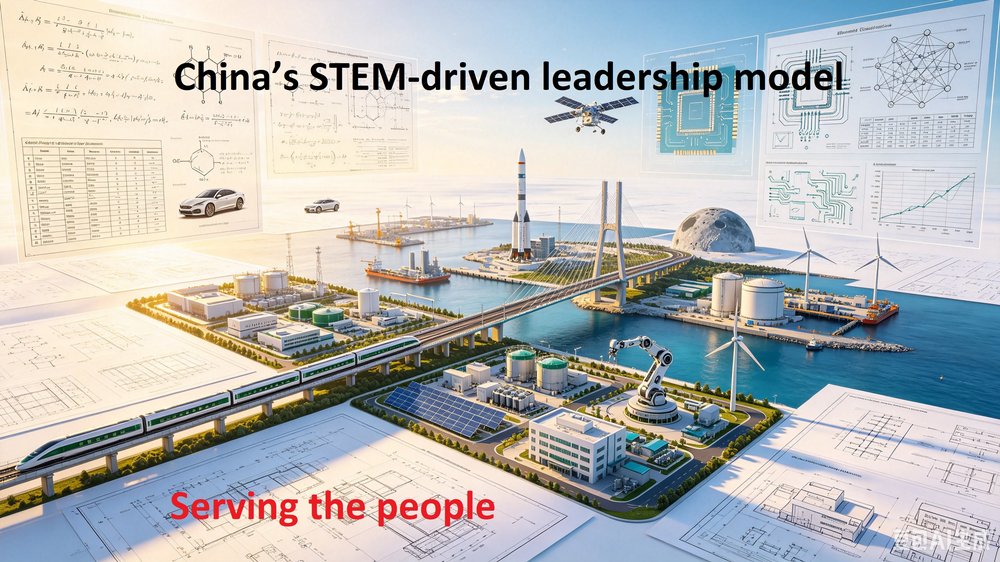
A distinctive feature of contemporary Chinese governance is the unusually high proportion of political leaders with backgrounds in science, technology, engineering and mathematics (STEM). At both the provincial and national levels, China’s leadership ranks are populated by individuals trained in fields such as engineering, physics, science and mathematics. This article examines the relationship between China’s STEM-heavy leadership composition and its governance outcomes, drawing on empirical data regarding leadership backgrounds, cognitive ability studies and governance performance metrics.
The STEM composition of China’s political leadership
National level leadership
Xi Jinping, China’s President and Chairman of the Communist Party of China, has a Chemical Engineering degree from Tsinghua University.
In the Politbureau, there are 6 members with a STEM degree.
Former presidents: Jiang Zemin has a degree in electrical engineering, Hu Jintao has a degree in Hydraulic Engineering, Wen Jiabao has a degree in Geological Structure.
Provincial-level leadership
The prevalence of STEM-trained officials at China’s provincial level is well documented. A 2023 analysis found that among China’s 31 provincial Party secretaries, at least 19 have理工科 (science and engineering) academic backgrounds. Many of these officials hold advanced degrees from China’s most prestigious institutions. Examples include Ni Yuefeng (Hebei Provincial Party Secretary), who holds a PhD in systems engineering from Tsinghua University specialising in automation and Hao Peng (Liaoning Provincial Party Secretary), who holds a master’s degree in aeronautical systems engineering from Northwestern Polytechnical University. At the governor and mayor level, the proportion with a science backgrounds is even higher.
Historical trends and the ‘technocrat’ phenomenon
The STEM dominance in governance is not a recent development but part of a decades-long trend. A quantitative study by Yang Zhusong and colleagues analysed 1 563 provincial Party Standing Committee members across China from 1983 to 2012. The research found that officials with full-time理工科 (STEM fields) academic credentials had consistently higher probabilities of promotion to senior provincial leadership positions. The ruthless selectivity of China’s Guokao (国考 National Civil Service Examination) is not unrelated to this.
The study identified three distinct phases, summarised in the table below.
| Period | Key finding |
| 1983–1992 | Engineering and economics graduates had higher promotion probabilities, corresponding to the rise of the ‘technocrat’ cohort. |
| 1993–2002 | Engineering remained significant; science master’s degrees began to show positive effects. Systematic training in STEM disciplines provided scientific literacy, logical thinking, superior analysis skills and practical problem-solving abilities. |
| 2003–2012 | Doctoral STEM degrees became the new standard, producing a cohort of ‘scholar-officials’ with advanced research credentials. |
The study concludes that China’s cadre selection system has consistently favoured officials with ‘more technically-oriented higher education’ who have developed strong capacities for ‘driving economic and social development and governance’ through multi-level, multi-sector experience.
National-level leadership
At the apex of China’s political system, the pattern is equally pronounced. Analysis of the State Council and Politburo indicates that more than 60% of top leaders have engineering, mathematics or applied science backgrounds. This includes figures with training in fields as diverse as rocket science, nuclear power safety and chemical engineering. According to a 2013 analysis, among 33 members of the State Council (including the Premier, Vice Premiers, State Councillors and ministry heads), at least eight had a STEM background and ten had economics or political science background.
STEM education and cognitive ability: what the data shows
The prevalence of STEM-trained leaders raises a logical question: does STEM education correlate with higher cognitive ability, and if so, what are the implications for governance?
The Olson dataset (2014)
In June 2014, data scientist Randy Olson, then a doctoral candidate in computer science at Michigan State University, published an analysis of average student IQ by college major. The data, curated by the Educational Testing Service (ETS), estimated IQ from SAT scores. Several studies have shown a strong correlation between SAT and IQ scores, making this a reasonable approximation. Olson’s findings, using the uncorrected figures, showed a clear hierarchy.
| Major | IQ |
| Physics and Astronomy | 133 |
| Mathematical Sciences | 130 |
| Philosophy | 129 |
| Materials Engineering | 129 |
| Economics | 128 |
| Chemical Engineering | 128 |
| Other Engineering | 128 |
| Mechanical Engineering | 126 |
| Computer and Information Sciences | 125 |
| Electrical and Electronics Engineering | 124 |
| Political Science | 122 |
| Chemistry | 122 |
| Humanities and Arts (other) | 122 |
| Industrial Engineering | 121 |
| Arts – History, Theory and Criticism | 121 |
| Law | 120 |
| Foreign Languages and Literatures | 120 |
| Earth, Atmospheric and Marine Sciences | 120 |
| Business (other) | 119 |
| Business Administration and Management | 119 |
| Civil Engineering | 119 |
| Banking and Finance | 119 |
| Religion and Theology | 118 |
| Library and Archival Sciences | 118 |
| Biological and Biomedical Sciences | 118 |
| English Language and Literature | 118 |
| Accounting | 117 |
| History | 117 |
| Architecture and Environmental Design | 117 |
| Arts – Performance and Studio | 117 |
| Education (Secondary) | 116 |
| Anthropology and Archaeology | 116 |
| Public Administration | 116 |
| Sociology | 116 |
| Education (other) | 115 |
| Agriculture and related fields | 115 |
| Administration | 107 |
| Home Economics | 106 |
| Special Education | 106 |
| Student Counselling | 105 |
| Early Childhood Education | 104 |
| Social Work | 103 |
Several important observations emerge from this data. First, STEM fields consistently rank at or near the top. Physics (133), Mathematics (130), and Engineering fields (124-129) significantly outrank most humanities and social science disciplines.
Second, the gap is substantial. The difference between Physics (133) and Sociology (116) is 17 IQ points, more than one standard deviation. The gap between Physics and Social Work (103) is 30 points, two standard deviations.
Third, the pattern is uniform.
Philosophy (129) ranks close to the STEM fields. Economics (128) and Political Science (122) perform somewhat better in the lower ranks of the sociology group.
The Wai research programme
Olson’s findings align with a broader research programme conducted by Duke University researcher Jonathan Wai (now at the University of Arkansas). Compiling data from five independent measures of academic ability spanning 1946 to 2014, Wai found an ‘invariably predictable order’ in how college majors ranked from highest to lowest aptitude. Physical sciences and engineering averaged approximately 119 IQ, while social sciences averaged 112. Wai’s 2022 study of 1.6 million GRE test-takers further confirmed that individuals pursuing STEM degrees had stronger quantitative than verbal skills, while arts and humanities students showed the opposite pattern.
Comparing the Olson and Wai studies, one can conclude that in Western countries, the IQ gap between STEM and sociology is rapidly growing.
Governance outcomes: China in comparative perspective
If we accept that China’s leadership is disproportionately STEM-trained and that STEM training correlates with higher analytical and quantitative ability, the logical next step is to examine whether this translates into superior governance outcomes.
Governance by Chinese definitions
Any meaningful comparison must first acknowledge that ‘governance’, ‘democracy’, ‘human rights’ and ‘freedom’ are defined differently across civilisations. Western liberal frameworks are not universal yardsticks; they reflect specific historical and cultural trajectories.
Human rights (人权)
The Chinese conception of human rights is people-centred (以人民为中心). It holds that subsistence and development are the most fundamental human rights. For a country that lifted approximately 800 million people out of extreme poverty between 1978 and the present, this is not an abstract principle but a lived reality.
From this perspective, guaranteeing food, shelter, healthcare, education and employment for 1.4 billion people is the primary human rights obligation. Measurable outcomes include life expectancy rising from approximately 35 years in 1949 to approximately 78 years today (higher than the USA), universal health insurance coverage exceeding 95%, and the elimination of extreme absolute poverty.
As one analysis puts it, ‘In a capital-centred model, human rights are narrowly defined as voting and free speech. By contrast, China’s people-centred democracy is much broader embedded throughout the entire governance process’.
Democracy (民主)
China’s model is Whole-Process People’s Democracy (全过程人民民主). Unlike Western electoral democracy, whole-process democracy emphasises substantive participation of the people at all stages of governance: policy drafting, local consultations and implementation.
The system prioritises consultative democracy (协商民主) and consensus-building over winner-take-all elections. The goal is policy outcomes that actually benefit the people, rather than formalistic electoral procedures. This enables long-term strategic planning, such as five-year plans, to be executed consistently across administrations, undisrupted by electoral cycles.
Freedom (自由)
In the Chinese framework, freedom exists within the framework of law and collective order. True freedom requires a safe, stable and orderly social environment. Freedom is guaranteed by the rule of law, not from it. This conception prioritises freedom from gun violence (strict gun control), freedom from drug addiction (strict anti-drug laws), freedom from social chaos and insecurity and freedom to pursue economic opportunity in a stable, growing economy.
It also extends to press freedom and freedom of speech, but defined in explicit contrast to the Western model, which it views as media dominated by CIA-influenced outlets or oligarchs, and thus a vehicle for capitalist propaganda. This framework emphasises protection against the so-called “Lugenpresse” (lying press) by ensuring that public discourse serves the people rather than private commercial or political interests. The goal is not unrestricted expression that can be exploited to spread misinformation or social division, but rather a media environment that contributes to social harmony and informs the public constructively.
Personal freedom, in this view, is the liberty to act within a harmonious, peaceful and cohesive society. Individual actions are encouraged and protected so long as they contribute to social stability and collective well-being, rather than undermining them through selfishness or antisocial behaviour. True personal freedom, therefore, is not the licence to do whatever one pleases regardless of the consequences for others, but the ability to live, work and thrive in a secure, orderly and supportive community.
Measurable governance outcomes
When evaluated by these definitional frameworks and by universal metrics of material welfare, China’s governance performance is exceptional. The table below provides a comparative summary.
| Governance dimension | China | Western comparison |
| Poverty eradication | Approximately 800 million people lifted from extreme poverty since 1978. Historic and unprecedented. | Already wealthy baseline; poverty persists and is rising in some areas. |
| Infrastructure | High-speed rail, ports, airports, 5G and subways built at record speed. | Ageing infrastructure; slow project delivery due to litigation and bureaucratic gridlock. |
| Public safety | Homicide rate approx. 0.5 per 100,000 (among the world’s lowest). Strict gun control. | United States homicide rate approx. 6.0 per 100,000; European average lower but rising in the big cities. |
| Economic growth | Sustained high growth for decades; now leading in electric vehicles, batteries, solar and advanced manufacturing. | Slower growth; de-industrialisation concerns in some major key sectors. |
| Crisis response (e.g. pandemics) | Rapid lockdowns, mass testing and vaccine development; controlled outbreaks efficiently in early stages. | Mixed; some Western countries had slower initial responses, almost all EU countries had higher excess mortality. |
| Public trust in central government | Consistently high, exceeding 90% in multiple international surveys (Harvard Ash Center, Edelman Trust Barometer). | Declining trust in governments, parliaments and media in many Western nations. Most surveys show trust < 35% |
| Long-term strategic planning | Five-year plans and 30-year visions executed consistently across administrations. | Short-term electoral cycles undermine long-term investment and policy continuity. |
Martin Jacques, a British scholar, observes: ‘We don’t have any long-term central planning in most of the economies of the West, that makes the greatest difference in the ability of a country to anticipate’. He further notes that ‘the five-year plans are suited to the Chinese mentality and the Chinese idea of thinking long-term’.
Conclusion
Given the data presented, several conclusions follow. China’s political leadership is disproportionately STEM-trained, with more than half of provincial Party secretaries and over 60% of top national leaders holding Science and Engineering degrees. STEM training correlates with higher cognitive ability, particularly in quantitative and analytical reasoning. Physics, Mathematics and Engineering majors consistently rank at the top of IQ- studies. China’s governance model has delivered measurable results in poverty reduction, infrastructure development, public safety, economic growth and strategic planning. These outcomes align with China’s own definitions of human rights, democracy and freedom.
The logical inference is clear: China’s STEM-heavy, meritocratically selected leadership has been a decisive asset in achieving its national development goals. The combination of high analytical ability, systematic training and performance-based promotion has produced a governance system that is exceptionally effective at engineering national development.
Whether this constitutes ‘better governance’ in an absolute, universal sense depends entirely on which metrics one values. However, by the standards China has set for itself and by the measurable improvements in the lives of 1.4 billion people, the model has been demonstrably effective.
As Prof M.A. Noor concludes: ‘The Chinese governance model challenges the notion that Western-style democracy is the sole legitimate form of governance and advocates for a pluralistic understanding of democracy that respects the sovereignty and different development paths of different countries’.
References
Olson, R, ‘Average IQ of students by college major and gender ratio’, 25 June 2014. Available at: http://www.randalolson.com/2014/06/25/average-iq-of-students-by-college-major-and-gender-ratio/
National Center for Education Statistics, ‘Table 318.30: Bachelor’s, master’s, and doctor’s degrees conferred by post-secondary institutions by sex of student and field of study’, Digest of Education Statistics, 2019. Available at: https://nces.ed.gov/programs/digest/d19/tables/dt19_318.30.asp
Wai, J, ‘Distributions of academic math-verbal tilt and overall academic skill of students specialising in different fields: A study of 1.6 million graduate record examination test takers’, Journal of Intelligence, 2022
Wai, J, research on cognitive ability by college major (1946-2014), Duke University
Yang, Z, Yan, Y and Xu, H, ‘Towards “All-round Cadres”: Policy Priorities and Issue Diversity of Local Bureaucrats in China, 2005-19’
‘Whole-process people’s democracy’, white paper titled ‘China: Democracy That Works’, State Council Information Office, 4 December 2021. Available at: http://english.scio.gov.cn
Jacques, Martin, ‘China’s development is an inspiration for the world’, Qiushi Journal, 4 November 2022. Available at: https://en.qstheory.cn
Jacques, Martin, ‘The strategic blueprint behind China’s development: One five-year plan at a time’, China Today, 30 June 2025
Noor, M A, ‘China a true upholder of freedom’, China Daily, 18 March 2024. Available at: http://www.chinadaily.com.cn/a/202403/18/WS65f77bc4a31082fc043bd179.html
Thank you for reading! We’d love to hear your thoughts. Please share your comments here below and join the conversation with our community!
📄 Download PDF