
The IQ series, updated
2026-07-31
2
Views: 39
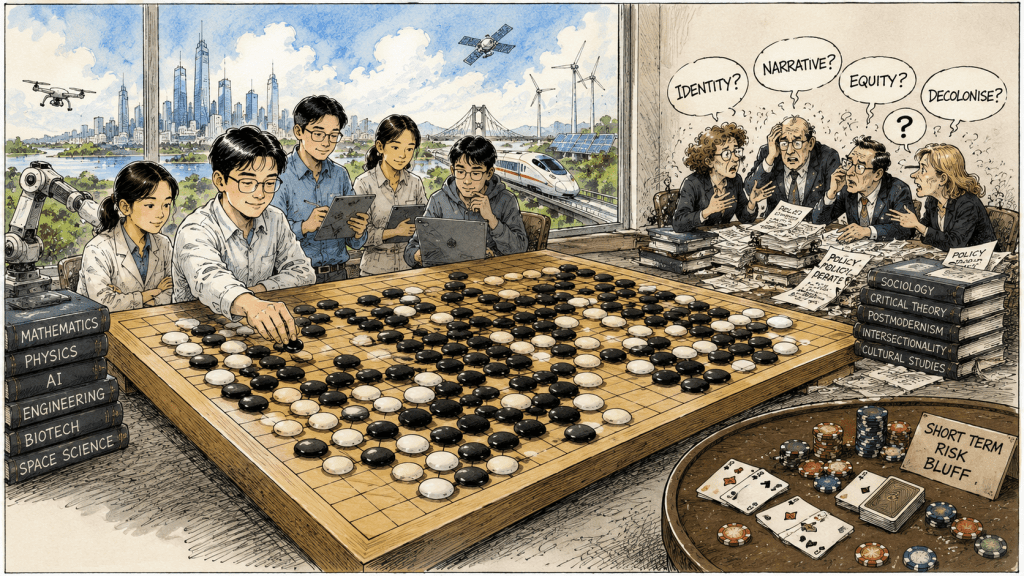
For years this website has argued a plain point: cognitive capital decides who leads and who follows in this century. The series below traces that argument from Chinese meritocracy through STEM education to the Flynn effect, and it keeps growing.
1. Intelligence and governance
- The level of intelligence of Chinese and Western politicians — 30 May 2024
In China, due to the harsh meritocratic system, almost all politicians are STEM graduates.
Chinese STEM-trained officials outscore Western sociology-trained politicians by some 25 IQ points on average. - How China selects its governing elite — 20 May 2024
The tyranny of the geniuses. The rule of the five percent.
China’s brutal meritocratic exams filter for the smartest five percent, a group Western politics rarely recruits. - The power behind the throne and the forever wars — 3 March 2024
We must take a stand or let our children fall, it’s that simple.
A guest essay on how international banking interests, not elected leaders, drive Western war policy.
2. Technology and innovation
- The future of technology is in China — 29 June 2022
I have unquestioning confidence in China’s technological future.
Firsthand accounts of Chinese engineering teams solving problems Western and German suppliers had given up on. - The brain game kicked off — 26 July 2022
Meritocracy and intelligence levels will predominate the global economy and politics.
China’s gaokao and Mensa growth are producing millions of exceptionally high-IQ graduates every year. - Medical technology — 21 June 2024
China’s medical technology has surpassed Europe’s top technology.
A trade fair in Stuttgart reveals that Chinese medical device makers now outpace their European rivals.
3. Societal dynamics
- The troubled Americans — 15 December 2024
America in crisis: navigating chaos, despair and a fading dream.
American political, social and technological decline is traced partly to a national taboo around discussing IQ. - Strategy is mathematics — 6 March 2023
The US strategy of failure, the boomerang strategy of the foot shot.
China’s disciplined, data-driven strategic planning is contrasted with repeated American foreign policy failures. - Chinese women — 9 October 2023
Never underestimate Chinese women.
Chinese women’s dominance in STEM fields, in business and in the PLA is examined through the lens of endurance and grit.
4. Historical and philosophical context
- The historical cycle of rise and fall of civilisations — 2 December 2023
Chinese researchers have found a second answer.
A republished study of Qin Hui’s theory on how democracy and checks and balances break China’s dynastic cycle. - Political consciousness — 29 June 2022
In the West, within the next generation, infant conditioning may prove more efficient than clubs and prisons.
In China, higher Chinese IQ, STEM education and a rising Flynn effect are named as drivers of political awareness. - The supersmarts — 13 June 2024
China’s cohort of extraordinary intelligent people.
Three decades after “The Bell Curve”, China’s cohort of exceptionally high-IQ citizens keeps widening the gap with the West.
5. The reckoning and its sequels
- How cognitive decline will bring down the West — 5 February 2025 (part 13)
The socio-economic and strategic consequences of educational failure in the West.
Educational collapse in the West is set against China’s rising cognitive capital, with grim forecasts for GDP and defence. - Artificial intelligence and high IQ in the geopolitical cognitive arena — 27 February 2025 (part 14)
Assessing dominance, policy impacts and the future of human-machine strategic competition.
AI and human high intelligence are compared as complementary strengths, with China’s STEM lead again in the frame. - The STEM-sociology clash — 9 May 2025
Quantitative rigour vs ideological echo chambers in higher education.
The IQ gap between STEM and sociology graduates is used to explain why Western leadership keeps failing.
Most recent
- China’s STEM-driven leadership model — 10 August 2026
An examination of leadership composition, cognitive ability and governance.
Cognitive composition of political leadership is weighed against governance outcomes, again unfavourably for the West. - Flynn in reverse: the hidden crisis undermining Western civilisation — 17 August 2026
Educational failure and sociological indoctrination have created a population incapable of sustaining Western civilisation.
For thirty years the Chinese population has grown smarter while Western populations have grown less so.



USA remains number one in the following:
-higher education rankings (internationally recognized)
-military prowess (ultimately the #1 factor in acquiring superpower status)
-nobel prizes given (China has a paltry amount, less than India)
-open debate, critique and dissent (acting as a society error-correction function and fueling adaptation and change)
Alot of your claims about chinese meritocracy and stem aptitude are not internationally benchmarked. It’s all smoke and mirrors. If you really believe this narrative, then start citing internationally standardized measures that prove your claims of chinese STEM aptitude and high IQ.
J.R.,
Thank you for taking the time to read my article and to share your thoughts. You raise four distinct points, and I appreciate the opportunity to address them directly.
First, let me address your overarching accusation that my claims are ‘not internationally benchmarked’ and amount to ‘smoke and mirrors’. This is factually incorrect. My article explicitly cites Randy Olson’s analysis, which uses United States Educational Testing Service data (SAT scores) to estimate IQ by major, and Jonathan Wai’s research programme at Duke University, which analysed 1.6 million United States GRE test-takers. These are internationally recognised, United States-based standardised measures. I am applying United States psychometric data to analyse the cognitive aptitude of STEM graduates. If you accept the SAT and GRE as legitimate metrics for American students, the logical inference about the cognitive profile of STEM-trained officials stands on firm empirical ground.
Now, to your four specific points.
1. Higher Education Rankings
You are correct that the United States has traditionally held the top spots in many global rankings. However, you significantly understate China’s current position. In the latest subject-specific rankings for STEM fields, Chinese universities are now filling the top ten positions in disciplines such as engineering, computer science, and materials science. For example, in the U.S. News Global Subject Rankings, Tsinghua University ranks first in several engineering categories, and multiple Chinese institutions now occupy the top five globally in artificial intelligence and renewable energy research. Two decades ago, this was unthinkable. This meteoric rise is a direct consequence of the STEM-driven, long-term strategic investment in education and research and development that my article describes. The existence of American Ivy League institutions does not disprove China’s success; rather, it proves that China’s governance model is effectively closing a historic gap at an unprecedented speed.
2. Military Prowess
I agree with you that the United States remains the world’s leading military power in terms of budgetary expenditure and advanced weaponry. However, military might is not the ultimate determinant of superpower status if it cannot be translated into strategic victory. The United States military was terribly defeated in Vietnam, Afghanistan and Iraq, despite overwhelming technological superiority. These conflicts demonstrate that raw military power, without coherent long-term strategy and understanding of local conditions, can become a liability rather than an asset. By contrast, China’s defence modernisation is systematic, patient and tied to clear economic and strategic objectives. The STEM-heavy leadership, including officials with backgrounds in rocket science and aeronautical engineering, has been instrumental in executing this defence strategy without overextending into unwinnable quagmires. Acknowledging American military spending does not negate the effectiveness of China’s developmental model; it highlights what a focused technocracy can achieve in a few decades of disciplined investment.
3. Nobel Prizes
This is a popular talking point, but it requires a more critical historical and political perspective. The Nobel Prizes, and especially the Peace Prize, are increasingly viewed as instruments of Western cultural and political imperialism. The selection process is opaque, dominated by Norwegian and Swedish committees that reflect a narrow European worldview, and the awards have frequently been given to figures and organisations that serve Western foreign policy interests. Recent recipients of the Peace Prize have included politicians and activists whose selection appears motivated more by geopolitical convenience than by genuine contributions to global peace. One might reasonably ask why a prize that overlooks the lifting of 800 million people out of extreme poverty is considered a credible measure of civilisational merit. If we look instead at contemporary, forward-looking metrics, such as the Nature Index for high-quality STEM publications, global patent filings (China leads in patents for artificial intelligence, batteries and renewables), and total research and development spending (China now spends over 2.6 per cent of GDP, rivaling the United States in absolute dollars), China is currently outpacing almost every nation. The STEM aptitude is clearly measurable in today’s engineering outputs, not in twentieth-century award ceremonies controlled by Western committees.
4. Open Debate, Critique, and Dissent as ‘Error-Correction’
This is the most philosophical point, and it hinges on how a society corrects errors. You argue that Western dissent fuels adaptation. However, I would counter that this model has increasingly led to political gridlock, policy paralysis, and extreme polarisation, which are themselves severe societal errors. For example, United States infrastructure spending takes decades due to litigation and partisan wrangling, while China builds high-speed rail networks and modern airports in a few years. Regarding public safety, the United States homicide rate, approximately 6.0 per 100,000, is twelve times higher than China’s rate of approximately 0.5 per 100,000. Which system is correcting the error of gun violence more effectively?
China’s ‘error-correction’ operates through internal party discipline, policy piloting, such as Special Economic Zones, and long-term feedback loops embedded in its five-year plans. The Harvard Ash Center survey, which I cited, shows over 90 per cent public trust in the central government, a metric that suggests the Chinese people perceive their government as effectively correcting errors and delivering tangible well-being. Ultimately, if ‘debate’ does not translate into measurable improvements in life expectancy, public safety, and poverty reduction, it remains a procedural virtue rather than a substantive one.
In conclusion, my article does not argue that the United States lacks strengths. It argues that China’s deliberate selection of high-cognitive-ability STEM graduates for leadership roles correlates empirically with extraordinary material and developmental outcomes. The metrics I cited, such as life expectancy, poverty reduction, infrastructure development, and public safety, are globally standardised by the United Nations, the World Health Organisation, and the World Bank. They are not ‘smoke and mirrors’; they are hard data.
I invite you to engage with those specific empirical outcomes rather than dismissing the entire argument based on a perceived lack of citations, which, as shown above, are plentiful and internationally sourced.
Best regards,
Frans Vandenbosch