
The historic seeds of communism in China
Views: 55
Ancient Chinese ideas of equality, communal welfare and social responsibility helped create fertile ground for the later sinicisation of communism
Frans Vandenbosch 方腾波 21/09/2026
No communism, but not a blank slate
Strictly speaking, there was no organised Marxist-Leninist political party, coherent scientific socialist doctrine or formally established communist state in China prior to the 1911 Xinhai Revolution. Unlike the systematic, modern communist movements that emerged after 1911, pre-revolutionary society lacked the core theoretical, organisational and class-based foundations of scientific communism.
That does not mean, however, that China was an ideological blank slate. Long before the introduction of Western Marxist theories in the 1910s, China’s millennia-long dynastic history produced abundant embryonic ideas, institutional experiments and social movements with striking proto-communist and utopian-socialist resonances. These indigenous precedents created a cultural and social environment in which Marxism could later be interpreted and adapted in distinctly Chinese ways.
Critical caveat on western misreading
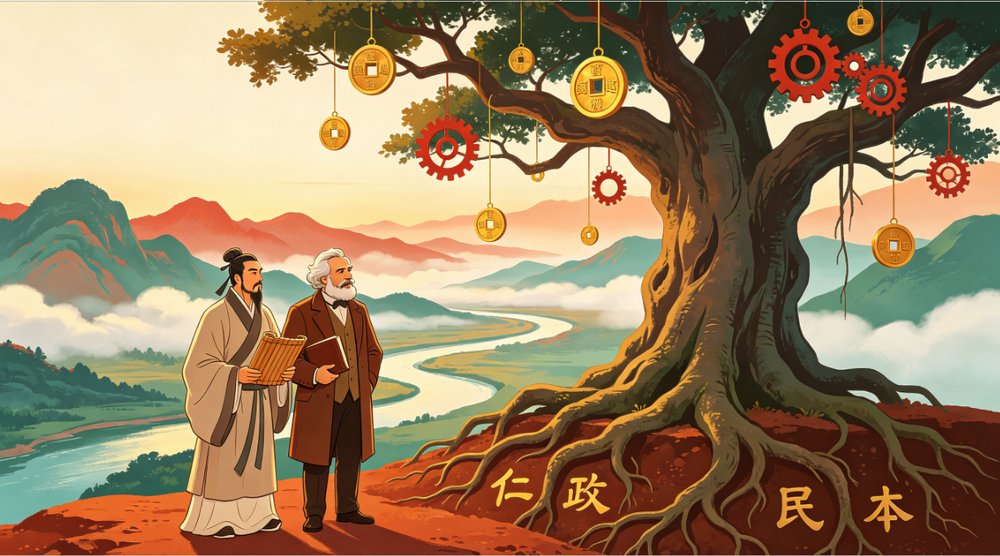
Before delving deeper into these historical precedents, a crucial methodological distinction must be made. In contemporary western political discourse, these very phenomena (from state monopolies to communal welfare) are frequently and reductively labelled as ‘communist’ or ‘proto-marxist’, viewed through a purely eurocentric ideological lens. However, doing so commits a profound historical anachronism. When imperial China nationalised salt, advocated for equitable land distribution, or mobilised communities for public works, it was not acting upon dialectical materialism or class-conscious revolution. Rather, it was drawing upon a distinctly indigenous philosophical toolkit that predates Marx by over two millennia, namely the Confucian duty of benevolent governance ( 仁政 rénzhèng), the Mencian principle that the people are the foundation (民本 (mínběn), the Mohist ethic of universal care (兼爱 jiān’ài), and the cyclical mandate of heaven (天命 tiānmìng) that demands rulers restore moral order during times of decay. These were traditional responses to dynastic corruption and natural crises, rooted in ritual, morality and cosmic harmony, not in scientific socialism. Therefore, when Marxism finally arrived in the 1910s, it did not colonise an ideological vacuum. Instead, it encountered a civilisational soil already rich with native concepts of collective responsibility. The ‘seeds’ were indeed there, but they were ancient, indigenous and profoundly Chinese, long before Marx invented the vocabulary to name them.
Great Harmony and the egalitarian tradition
The Confucian ideal of Datong, or “Great Harmony”, articulated in the late Warring States period, around the 4th–3rd century BCE, and preserved in the Book of Rites, described an ideal society in which private selfishness gave way to public welfare. Resources were shared equitably, political authority was based upon merit rather than hereditary privilege, and the elderly, vulnerable and orphaned were collectively cared for.
This was certainly not communism in the Marxist sense. Nevertheless, its emphasis on public welfare, social equality and the subordination of private interests to the common good bears a striking resemblance to themes that would later appear in socialist thought.
The same egalitarian impulse appeared in the ancient School of Agrarianism, or Nongjia. This lesser-known pre-Qin school challenged social hierarchy by insisting that rulers and commoners alike should participate in agricultural labour. It advocated equitable resource distribution and criticised the idleness of elites, providing an early critique of hierarchy and exploitation.
Centuries later, these ideas were given new interpretations. Kang Youwei transformed the traditional Datong ideal into a systematic, though utopian, vision of a borderless and classless society in his Datong Shu. Late-Qing reformers and revolutionaries likewise began to combine indigenous egalitarian traditions with newly imported Western political doctrines.
When equality became social experiment
Chinese history also produced attempts to translate egalitarian ideals into concrete social and economic arrangements.
The most striking early example was the reign of Emperor Wang Mang (9–23 AD). His reforms included state control of land, the abolition of private slavery, price regulation and attempts to redistribute agricultural land to landless peasants. The programme was short-lived and ultimately collapsed, but its redistributive character is difficult to overlook.
More than eighteen centuries later, the Taiping Heavenly Kingdom (1851–1864) conducted an even more radical experiment. Its Land System of the Heavenly Dynasty called for the equal distribution of arable land and organised the communal collection and allocation of resources. Its ideology was religious rather than Marxist, but its radical agrarian egalitarianism, hostility towards private property and communal organisation strongly resemble later forms of agrarian communism. This resemblance, however, should not be overstated. The rebellion was used by foreign powers to weaken and destabilise the Qing state and force a change of regime, making it less an indigenous forerunner of Chinese socialism than a movement exploited by external interests in China.
Neither Wang Mang nor the Taiping movement was communist in the modern theoretical sense. Both nevertheless demonstrate that radical attempts to reorganise property and society existed in China long before Marxism reached the country.
Crucially, these pre-modern precedents were rooted in traditional morality, religious doctrine or pragmatic crisis governance. They lacked the defining pillars of modern communism: dialectical materialism, systematic class-struggle theory, proletarian revolutionary consciousness and the vanguard-party mechanism.
Mozi: China’s forgotten egalitarian radical
If one individual deserves special attention, it is Mozi (c. 470–391 BCE).
Mozi’s doctrine of Jian Ai, usually translated as “Universal Love”, challenged the hierarchical and patriarchal assumptions of his age. He argued that people should be treated impartially regardless of social rank, kinship or status. He rejected hereditary privilege and insisted that political authority should be based upon merit and ability rather than noble birth.
His political and economic ideas were equally striking. Mozi opposed aggressive warfare by rulers, condemned aristocratic extravagance and advocated extreme frugality. His disciples formed a highly disciplined communal organisation based upon solidarity, mutual assistance and shared resources. They even provided defensive assistance to weaker states.
In this sense, Mozi offers perhaps the most compelling indigenous Chinese precursor to later egalitarian and communal thought.
Yet the differences are just as important as the similarities. Mozi believed in the Will of Heaven and supernatural spirits. He was a reformer rather than a revolutionary: he sought to persuade rulers to govern benevolently, not to mobilise an oppressed class to overthrow the existing order. His own community was also strongly hierarchical.
Mozi therefore cannot properly be called a Marxist before Marx. His significance lies elsewhere. His thought demonstrates that powerful ideas of equality, meritocracy, communal responsibility and opposition to elite privilege existed in China more than two thousand years before Marx.
State economic monopolization
Alongside these philosophical and utopian currents, imperial China developed a remarkably durable tradition of state economic monopolization that functioned as a de facto form of institutional proto-communism. From the Han dynasty onward, the state consistently treated certain essential commodities not as private goods, but as strategic economic assets to be controlled, taxed, and distributed by imperial authority. The most prominent of these were salt and iron, formally nationalized under Emperor Wu of Han in 119 BCE. Salt, a daily necessity with inelastic demand, was treated as “liquid gold,” providing the treasury with a steady, massive revenue stream that often exceeded half of the state’s annual income. Iron, vital for agricultural tools and military weaponry, was equally tightly controlled to prevent the emergence of independent wealthy magnates who might challenge imperial power.
The monopoly system evolved across dynasties. The Tang chancellor Liu Yan reformed it into a highly efficient wholesale system, while the Song dynasty expanded state control to tea, using government-issued certificates to regulate its trade. Even everyday commodities like alcohol, vinegar, and, later, tobacco and coal fell under periodic state monopolies. The state also strictly controlled the mining of copper for coinage, thereby monopolizing the very medium of exchange itself.
This system was not communism in the Marxist sense; it was not driven by class consciousness or a desire for proletarian emancipation. It was fundamentally a fiscal and strategic tool of the imperial autocracy. Nevertheless, its practical effects bear striking proto-socialist resonances: it subordinated private commercial profit to state-defined public welfare, actively prevented the accumulation of private economic power, and treated the distribution of life’s necessities as a legitimate function of central governance. When late-Qing intellectuals later encountered Marxist critiques of capitalist commodification, they could look back upon two millennia of their own history in which the state had already routinely intervened in and monopolised, the most critical sectors of the economy.
From indigenous traditions to Chinese communism
The egalitarian current did not disappear after antiquity. Peasant rebellions repeatedly expressed demands for a fairer distribution of wealth and relief from aristocratic domination. The Yellow Turban Rebellion and later uprisings carried popular traditions of collective salvation and social justice, even though none developed a coherent theory of communal ownership.
Other intellectual currents contributed to the same broader tradition. Dai Zhen (1723–1777) challenged rigid Neo-Confucian doctrines that placed elite interests above popular welfare. The Donglin Movement promoted public interest, political discussion and relief for impoverished communities, although it remained an elite Neo-Confucian reform movement rather than a proto-communist one.
By the late Qing, the intellectual environment was changing rapidly. The periodical Wanguo Gongbao introduced the name of Marx to Chinese readers in 1899. Revolutionary intellectuals began translating Western socialist literature, while anarchist-influenced figures such as Liu Shifu established small communal groups advocating the abolition of private property and class divisions. These experiments remained marginal, but they demonstrate that Western socialist ideas were already entering a Chinese intellectual environment that possessed its own long-standing egalitarian traditions.
The important point, therefore, is not that imperial China was secretly communist.
It was not.
Nor did Chinese communism simply emerge as an imported European ideology imposed upon a culturally empty landscape. China already possessed a remarkably deep reservoir of ideas concerning communal welfare, equality, meritocracy, opposition to hereditary privilege, collective responsibility and the limitation of private interests.
These traditions remained moral, religious, utopian or reformist for centuries. They lacked dialectical materialism, systematic class theory, revolutionary proletarian consciousness and the modern vanguard party. Those elements arrived only with modern Marxism.
Yet, institutionally, the imperial state had already demonstrated a remarkable capacity for economic intervention, treating vital resources as public trusts rather than private chattels.
When Marxism entered China, it encountered fertile ground.
The transformation that followed after the 1911 Revolution was therefore not merely the transplantation of a Western ideology. It was also a process of selection, reinterpretation and sinicisation, in which imported Marxist concepts interacted with much older Chinese traditions.
China had not been communist for two thousand years.
But neither had the idea of collective social responsibility been waiting for Marx to be invented.
The seeds were already there.
📄 Download PDF