
The five stages of western decline
Views: 108
A study in civilisational grief
Frans Vandenbosch 方腾波 16/03/2026

Symptoms
A French veteran shouts at a Beijing waitress in a language she does not understand. Young Americans drift through Shanghai, certain the world owes them a living, and then vanish. These are small scenes, easily dismissed as anecdotes. But they are not isolated. They are the visible symptoms of a much larger phenomenon.
The West is no longer the centre of the world. This is not a prophecy. It is a fact, measurable in GDP tables, language enrolment statistics, and the quiet closing of diplomatic doors. The shock of this reversal is still being processed.
Elisabeth Kübler-Ross, studying the terminally ill, identified five stages of grief: denial, anger, bargaining, depression and acceptance. Her model was never meant to be a rigid ladder. People move back and forth, skip stages, get stuck. But as a framework for understanding how individuals process irreversible loss, it has proven durable.
This essay applies that framework to something larger. Nations, too, can grieve. Empires, too, can find themselves trapped in stages they cannot escape. Over three chapters, we will trace how the West is navigating its own decline: first the symptoms, then the model, then the diagnosis. The question is not whether the loss has occurred. The question is whether acceptance will ever come.
The incapability to adapt to another culture
In Hanoi, many years ago, I observed a middle-aged French tourist speaking French to a street vendor. The young Vietnamese woman did not understand a single word of it. She tried to explain in English that they needed another language to communicate.
The French woman seemed trapped in a bygone era. She appeared unaware that French is no longer the lingua franca in Vietnam, a status it held during the colonial period .
Today, fewer than one per cent of Vietnam’s population speaks French. In 2024, only 400 high school students chose French for their graduation exams. More than 358,000 selected English, and approximately 4,400 opted for Chinese. For young Vietnamese, these languages offer more practical value for their future.
A similar incident occurred in a Beijing restaurant in 2002. An elderly French veteran, noticing I had secured a good table by speaking Chinese, began shouting at the waitress in French. He claimed that as a Second World War veteran, he deserved the spot by the window. The waitress, who obviously did not understand French, was visibly startled by his outburst.
I intervened and explained to the old gentleman in French that shouting was unnecessary. People in China, I told him, do not speak French. This reflects China’s practical approach to language, which prioritises English, and increasingly, the languages of its immediate neighbours.
These encounters highlight a significant cultural and linguistic shift. The old certainties of European colonial influence are fading. They are being replaced by a new, more complex reality where Asia’s own dynamics take centre stage. For the younger generations in Vietnam and China, the languages they choose to learn are about future opportunity, not past empire.
In 2003, amidst the height of the SARS epidemic in Southeast Asia, I embarked on an extensive tour through the remote areas of Myanmar. At the conclusion of my journey, I flew from Yangon to Bangkok aboard a small Embraer EMB 110 Bandeirante, a turboprop aircraft known for its compact size. The plane was nearly full, carrying approximately 20 other passengers. Among them were four middle-aged French tourists.
As we crossed the airspace into Thailand, a Thai flight attendant began distributing health declaration cards; a standard procedure during the epidemic. The cards were small, roughly A5 in size, printed in English on one side and Thai on the other. The absence of a French translation, however, caused an immediate and disproportionate reaction from the four French passengers. Holding the cards as if they were offensive objects, they made no move to complete them. Instead, two of them stood up in the aisle and began shouting at the flight attendant: in French. She, understandably alarmed and unable to comprehend them, hurried to the cockpit to alert the pilot. Watching the situation escalate, I attempted to mediate. I approached the group and, speaking French to them, offered to help them fill out the cards in English. They refused outright, their indignation seemingly rooted more in principle than practicality. To this day, I remain unsure how they managed to pass through border control upon landing in Bangkok.
In the early 2000s, I observed many young Americans arriving in Shanghai. They came without clear plans or much education. They enjoyed life in big steak restaurants and jazz clubs, drawn by the city’s bright lights. When I asked about their business in China, they gave vague answers. They often claimed the Chinese government was boycotting them. I pointed out that German companies were thriving there. I suggested they adopt a German approach: be disciplined, humble and hard-working. They laughed at me. That was not why they came.
By 2016, years before the pandemic and the trade war, I noticed most had left. Their businesses failed. The steak restaurants and jazz clubs closed. German companies, however, continue to make huge investments across China today. The Americans, unable to adapt to the Chinese business culture, could not compete. A bygone era for the American dream in China.
These encounters, spanning two decades and multiple countries (the French tourist stranded by history in Hanoi, the French veteran shouting in a Beijing restaurant, the French passengers refusing to fill out a simple health card on a Bangkok-bound flight and the American expats defeated by Shanghai’s business culture) are not merely isolated anecdotes of personal failure. They are the human-scale symptoms of a much larger phenomenon. These individuals were not just struggling with a new culture; they were unwittingly acting out the first, disoriented stages of a collective grief process. They were living evidence that their home nations have not yet come to terms with a fundamental loss. To understand what we are witnessing, we must first understand the nature of grief itself.
The five stages of grief
Over the years, various researchers have put forward different frameworks for the stages of the grieving process.
Elisabeth Kübler-Ross is the most prominent figure in this field. A Swiss-American psychiatrist, she introduced the 5 stages of grief (often called the Kübler-Ross model) in her landmark 1969 book On Death and Dying.
The five stages are
Denial
Anger
Bargaining
Depression
Acceptance
Her research was based on interviews with terminally ill patients at the University of Chicago. It’s worth noting that she never intended these stages to be seen as a strict linear progression. People can move between them, skip some, or revisit others.
Later, John Bowlby proposed a 4-phase grief model (shock, yearning, despair, reorganisation), later validated by Colin Murray Parkes. More recently, George Bonanno challenged stage-based models, finding resilience is the most common response to loss.
Political polarisation is at historic highs, economic inequality is growing, infrastructure is ageing, and trust in institutions is low. American soft power has declined following events like the Iraq War and the January 6th insurrection.
Barbara Walter’s How Civil Wars Start (2022) applies civil conflict research to the U.S., warning that political violence is a real risk as the country slides toward “anocracy.” Noam Chomsky’s work (e.g., Failed States, 2006) critiques American imperial overreach and corporate influence. Peter Zeihan (The Accidental Superpower, 2014) argues that America’s post-WWII global role is ending, leading to a fragmented world.
The five stages of civilisational grief
I enjoy absolutely no Schadenfreude in the rapid downfall of the USA, nor in France’s loss of its lingua franca.
The Kübler-Ross model, developed originally for individual loss, maps surprisingly well onto civilisational decline. Three cases illustrate this: the retreat of American hegemony, France’s loss of linguistic prestige, and Europe’s broader reckoning with its own diminishment. In each, we can trace the same stages: denial, anger, bargaining, depression, acceptance, playing out on a national scale.
Denial
The first stage is denial: the refusal to acknowledge that the loss is real or permanent. The United States remains deep in denial. “America is still number one” is the dominant political refrain. This persists despite a national debt exceeding 36 trillion dollars. China’s GDP has already surpassed America’s in purchasing-power terms. The MAGA slogan, “Make America Great Again”, implies greatness is present, not past. Decline is reframed as elite conspiracy, media distortion or a temporary setback. The loss is named but not accepted.
France passed through its own denial much earlier. The Académie française fought any suggestion that French was losing ground. The Toubon Law of 1994 mandated French in advertising, workplaces and public services. It was denial encoded in legislation.
Anger
The second stage is anger: frustration, blame, and the search for a target. American anger is now emerging. Punishing tariffs, culture wars, and the scapegoating of immigrants all signal stage two. The fury is not yet directed at decline itself. It is displaced onto proxies: China, Mexico, the European Union and coastal elites. The emotion is real. The target keeps shifting.
France’s anger was sharper and had a clearer object. Anti-Americanism became a defining feature of French diplomacy from the 1960s onward. De Gaulle withdrew France from NATO’s military command. Intellectuals raged against American pop culture and business English colonising the world. France did not simply lose a language. It felt robbed.
Bargaining
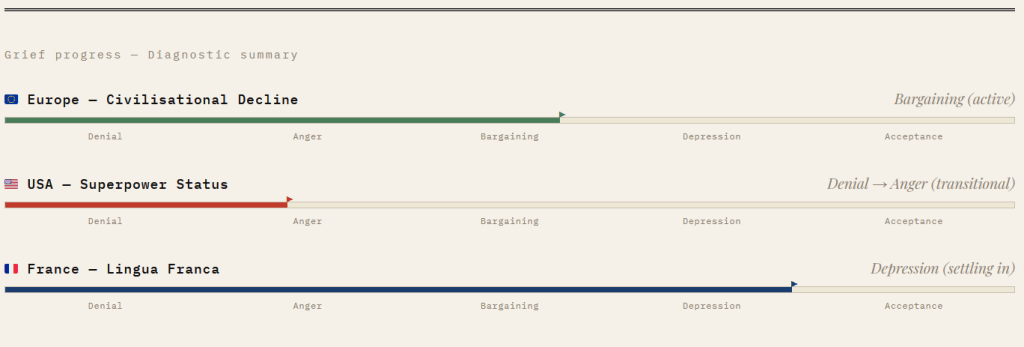
The third stage is bargaining: attempting to regain control through negotiation, promises or new strategies. Europe is now in the bargaining stage. The response to civilisational retreat has been institutional and collective. New defence doctrines are drafted. Strategic autonomy is declared. The European Union reframes itself as a geopolitical actor rather than a trading bloc. These are classic bargaining moves: preserving influence through agreements rather than dominance.
France has already passed through its own bargaining on the linguistic question. The tools were considerable. La Francophonie gathered 88 member states. The Alliance Française network extended worldwide. In 2018, Macron declared that French would be the world’s most spoken language by 2050. The bet was placed on African demographic growth. It was a bargain struck with demography rather than culture. The bargain did not hold.
The United States has not yet reached this stage. Glimpses appear in bilateral trade deals and the “America First” framing, which packages retreat as strength. But the full negotiation with decline has not yet begun.
Depression
The fourth stage is depression: the quiet despair that sets in when bargaining fails. France is now in depression on the linguistic question. The bargains failed quietly. French university departments are closing worldwide. EU corridors run on English despite formal equality between languages. French young people code-switch without apology. No argument is being made any more. There is a quiet awareness that this has settled. The language that once organised the world has become one great tongue among several. The Académie still legislates. Fewer people listen.
The United States has not yet arrived here. Depression comes when bargains fail and allies stop listening. It arrives when the dollar loses its reserve status or when military commitments can no longer be funded. A generation will have to accept that American primacy was an era, not a permanent condition. Britain offers the nearest historical parallel. It withdrew quietly from empire in the 1950s and 1960s. Its public absorbed the loss slowly and without ceremony.
Acceptance
The final stage is acceptance: not happiness, but a clear-eyed recognition of the new reality. Neither the United States, France nor Europe has reached acceptance. For America, it would mean reimagining the country as a leading nation in a multipolar world. It would mean being influential and prosperous, but no longer the singular power. The United States has no cultural memory of how to be otherwise. The question has not yet been seriously asked.
For France, acceptance would mean celebrating the language as a great literary and philosophical heritage. It would mean doing so without requiring French to be the global tongue. Some French intellectuals are privately already there. Institutionally, it remains close to heresy. Acceptance may require the Académie to stop legislating and start curating. French as the new Latin: revered, studied, beloved and free from the weight of relevance.
Europe and France: two different griefs
Europe’s grief is distinct from France’s. France grieves a specific, intimate wound: the loss of linguistic prestige. Europe grieves something broader. It is the loss of civilisational centrality, military self-sufficiency, demographic confidence and economic vitality. These are absorbed facts across much of Western Europe. They produce a quiet, collective bargaining that has not yet curdled into depression. France is further along. It is already in the stillness that follows when the arguments have stopped.
Coda
The Kübler-Ross model was never a judgment. Denial, anger, bargaining, depression: these are human responses to unbearable loss. Nations deserve the same charity.
America remains in denial, still believing the old order can be restored. Europe is bargaining, drafting strategies while the ground shifts. France, on the language question, has arrived at a quiet depression. None have reached acceptance.
The stories that opened this essay, the veteran shouting in Beijing, the tourist stranded in Hanoi, the Americans drifting through Shanghai, were not personal failures. They were previews. They showed what happens when individuals arrive in a new world while their nations remain trapped in an old one.
Whether the West will ever reach acceptance is an open question. Britain managed it after 1945. It took a generation. America and Europe may yet do the same. But the first step is to recognise that grief is what this is.
The five stages of western decline are not yet complete. The final stage remains unwritten.
Which of these stages are you in, my dear reader? Which phase of this collective grieving process do you recognize in your own country, your community, or within yourself? I warmly invite you to share your thoughts on this in the comments below.
Dit artikel in het Nederlands: De vijf fasen van westers verval



I am now 95 years of age, born in Shanghai of Portuguese, German descent and now American having gone thru US prep and universities. My father though not of English descent emerged as a leader in a British global Textile/Wool company when Brit textiles then were considered primary in the world. Industrial post WW Two leadership was clearly American. Cninese industry was considered at best basic and in crafts. And I as a young executive given leadership in a US Financial Institution proclaimed US primacy in a world of Chinese craft excellence. This was the prevailing thinking of a US executive in Hongkong post college, serving my draft time in the Army, then after some time in Wall Street, was posted to Hongkong. Never at that time was any perception of Chinese parallel leadership in industry and finance existing today. It is only recognized somewhat today and certainly there is no recognition by the Trump administration of the diminution of US economic might expressed in both alarmingly and glowingly in its military presence in all too many arears of the world.
Frans, we met on the Internet through a mutual friend in the Netherlands. My wife and I have lived in Germany for 6 years in the 1960s and 6 years in Switzerland in the 1980s, always immersed in the German culture and people, not with American companies. I like your patient explanations about China, Europe, and the USA. Most Americans stick to the blind platforms of the Democrats or Republicans. Yes, the future for the American government, economy, and education system looks grim. Thanks for what you are doing to report on China, and analyze Europe and the USA.