Views: 0
The Chinese industry conquers the European market, sector by sector
Frans Vandenbosch 方腾波 31/08/2026
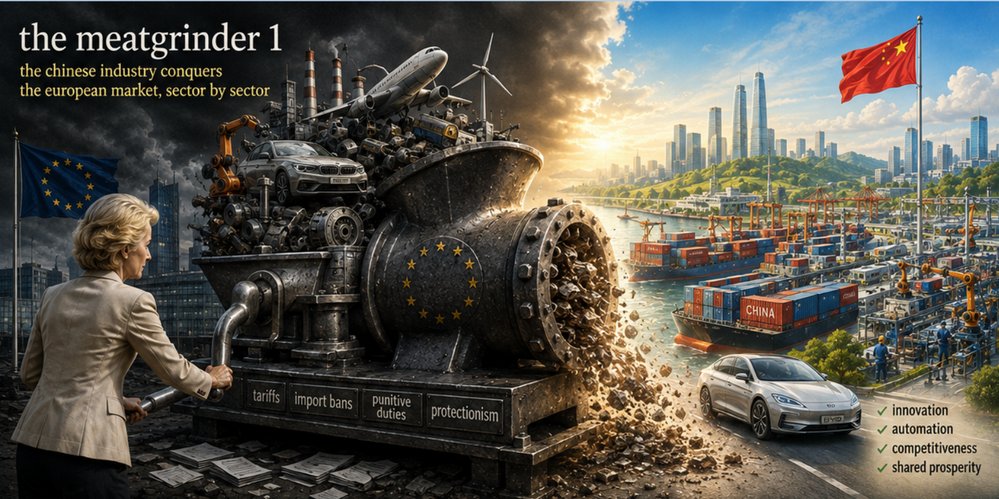
It wasn’t China that built the economic meatgrinder. The Brussels EU built it, feeding the European economy in piece by piece to please its American masters. The ultimate outcome of Von der Leyen’s actions will be that the Chinese economy, with its overwhelming size, superior competitiveness and many other strengths, will pulverize the entirety of European industry over the coming decade.
By resorting to protectionism, import bans and punitive tariffs, the EU is deliberately crippling its own economy. These measures are utterly futile; they will neither halt nor even slow Europe’s steep decline. Tariffs may, at first sight, appear to be protective shields against foreign rivals, but over time they reveal themselves as a slow-acting poison, systematically strangling European industry. Worse still, these very barriers paradoxically serve as an incentive, an accelerant for China, compelling its industries to leapfrog in innovation and automation at a blistering pace.
European and national politicians are perfectly cognizant of this self-destructive trajectory. They are not fools. Yet they deliberately implement these tariffs anyway, not for Europe’s benefit, but as a craven act of servitude to their American oligarchic masters. Make no mistake: the implementation of EU tariffs on Chinese goods is a calculated, destructive blueprint intentionally designed to sabotage the EU economy, dictated directly by a tiny cabal of ultra-wealthy Americans and rapacious financial conglomerates.
Most European multinational companies see this lethal charade with absolute clarity; they maintain lucrative footholds in China and understand the geopolitical chessboard better than anyone. Regrettably, they have been stripped of all political leverage. In a rare unified outcry, Mercedes-Benz, BMW and Volkswagen vehemently denounced the import tariffs on Chinese electric vehicles. The German industry titans are keenly aware of what Stellantis did to Fiat, Jeep, Lancia, Maserati, Opel, Peugeot, Ram and Vauxhall. Vanguard, BlackRock and Goldman Sachs are slowly strangling these European car brands. The desperate, last-ditch appeal of the German automotive giants was arrogantly swept aside and silenced in the corridors of Brussels.
The Chinese products in our European shops
From the cars we drive to the homes we build, Chinese manufacturing has woven itself into the fabric of European daily life, often surpassing traditional competitors in market share and quality.
Cars
There is much media fuss about Chinese electric cars arriving in Europe. Polestar and Volvo, both owned by Geely, have been on European roads for many years. Today, BYD is quickly conquering the EU car market. In mid-2026, according to EFTA figures, the five major Chinese automotive groups (Geely, SAIC, BYD, Chery and Leapmotor) had raised their combined EU market share to 13%, up from 7.9% in 2025. Chinese cars now hold a larger share than all Japanese brands combined (11%), while American brands Tesla, Ford and GM had a combined market share of 6%. We do not count Stellantis (Fiat, Chrysler, PSA, Jeep, ..) as American.
All European car brands, including the famous German marques, use at least 25% Chinese-made components, with some reaching up to 60%, even when the final assembly occurs within the EU.
Supermarkets
Aldi, Lidl, Zeeman, Action, Trafic, Kruidvat, Hema, Hubo, Gamma, Tom&Co …
Depending on the shop, the share of ‘Made in China’ products ranges from 20% to 90%. Kruidvat is owned by Chinese capital.
White goods and kitchen appliances
Chinese brands are emerging very quickly here. Haier (海尔), Midea (美的), Gree (格力), Hisense (海信), TCL (科技) and Xiaomi (小米) are pushing Miele, Bosch, Philips, AEG–Zanussi–Electrolux, Bauknecht–Indesit and others into the background. In the European non-premium market is Candy owned by Haier and Gorenje owned by Hisense.
Electric power tools
The era when Metabo, Black & Decker, Makita and Bosch were the only players on the market is long over. For decades, unbranded or own-branded power tools made in China have been available in DIY supermarkets. These days, with most people shopping online, the lion’s share of the market goes to well-known Chinese power tool brands.
Pharmaceuticals
Almost all KSMs, APIs and excipients used in the European pharmaceutical industry are made in China. For more insight, see ‘How China and the West manage pharmaceuticals differently’ at https://yellowlion.org/pharmaceuticals/.
Windows and doors
The market is still dominated by major European players such as Rehau, Deceuninck, Kömmerling, Veka, Aluplast and Schüco. But the Chinese are catching up fast. For an architect working on new buildings, it is more convenient and faster to order the windows and doors online from China than from the EU, with better quality and lower cost often cited as added benefits.
Houses
Already today, much of the building materials used in constructing houses, villas and apartments are made in China. Gradually, entirely finished houses, including ready installed electrics, heating, domotics, kitchens and bathrooms are being built in China and shipped in containers to Europe as modular building blocks, significantly reducing on-site construction time.
Airplanes
The global market is still dominated by the Airbus–Boeing duopoly. China’s C919, made by COMAC in Shanghai, appears to offer higher quality at a lower cost (see: Welcome aboard. The brand new Chinese Comac C919).
Unfortunately, the European Union Aviation Safety Agency (EASA) is deliberately slowing down the approval process for the C919 in Europe with ridiculous new requirements.
As of June 2026, some 42 C919 aeroplanes are already in daily use, with some operating international flights within Asia. My estimate is that within the next three to five years, the C919 will appear at European airports.
The reckoning
The evidence presented in this article paints a clear and troubling picture. European protectionism is not merely ineffective; it is actively destructive. By erecting tariff barriers and import restrictions under pressure from American financial interests, the European Union simultaneously poisons its own industrial base while accelerating China’s inevitable technological leap forward. The statistics are telling. Chinese cars now outsell Japanese and American brands combined in Europe. Chinese components are embedded in a quarter to three-fifths of all European vehicles. Chinese manufacturing dominates everything from pharmaceuticals to power tools.
The crux of the matter is that Europe cannot protect itself out of competition. The tariffs and bans that Brussels imposes do not shield European industry; they create a false sense of security while Chinese competitors innovate faster and produce better products at lower costs. The window for Europe to compete on equal terms is closing rapidly, and the political class appears either unwilling or unable to recognise this reality.
Ultimately, Europe faces a binary choice. It must adapt to the new global economic reality and find ways to compete alongside Chinese industry or it must continue down the path of protectionist servitude to American interests, a path that leads inevitably to industrial irrelevance. The meatgrinder is not of China’s making; it is Europe’s own creation, and it is consuming the very industries it was meant to protect.
Thank you for reading! We’d love to hear your thoughts. Please share your comments here below and join the conversation with our readers!
📄 Download PDF