
Views: 424
Elections in China are somewhat different from what’s happening in the west.
Frans Vandenbosch 方腾波 25.02.2024
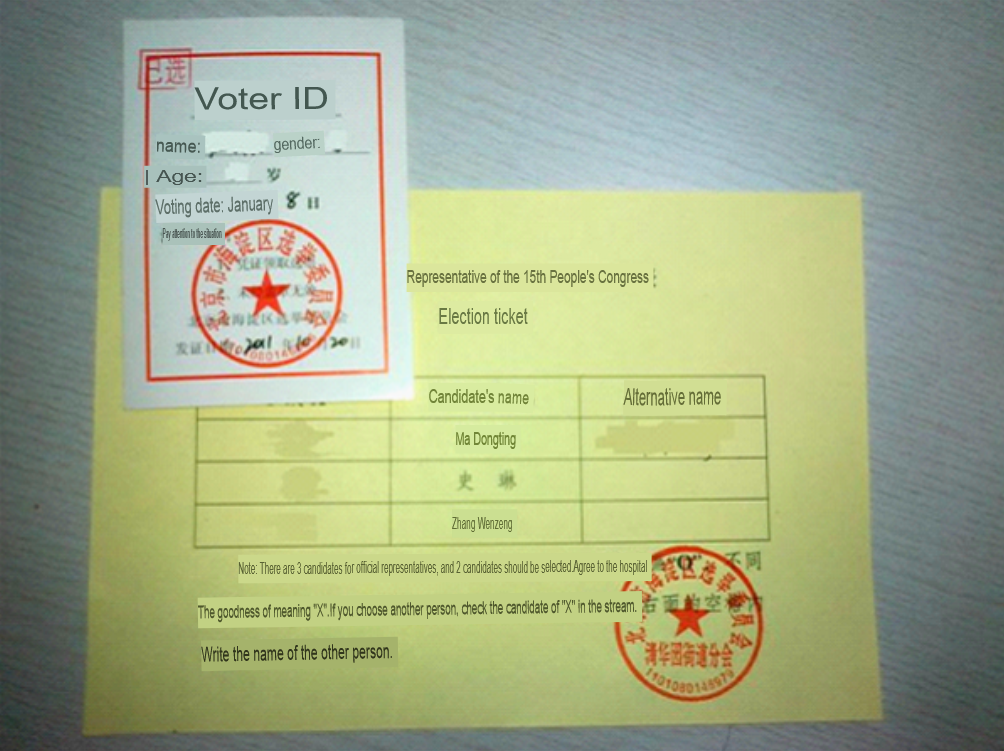
When I explain to my audience about political parties and elections in China during my lectures, there are people who do not believe me or outright claim that I am lying.
Every 5 years there are elections in China, usually in late autumn.
The picture above is showing a 选民证 xuǎnmín zhèng “Voting card” (the small white one) and a 选举票 xuǎnjǔ piào “Election ticket” (the yellow document)
Voting card
In China, people must register to vote, otherwise they cannot vote.
(Different from belgium, where voting is mandatory, there are fines if one doesn’t go voting)
This is a 选民证 xuǎnmín zhèng “Voting card”
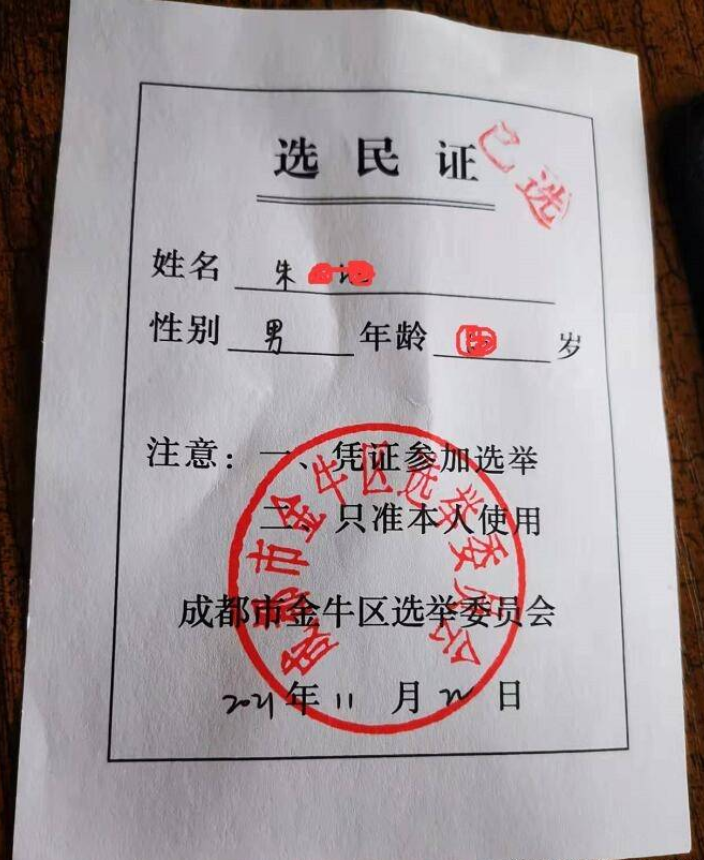
This document confirms that one has registered to go voting. The red stamp is the proof that one has voted.
The card here above was for the last elections in November 2021.
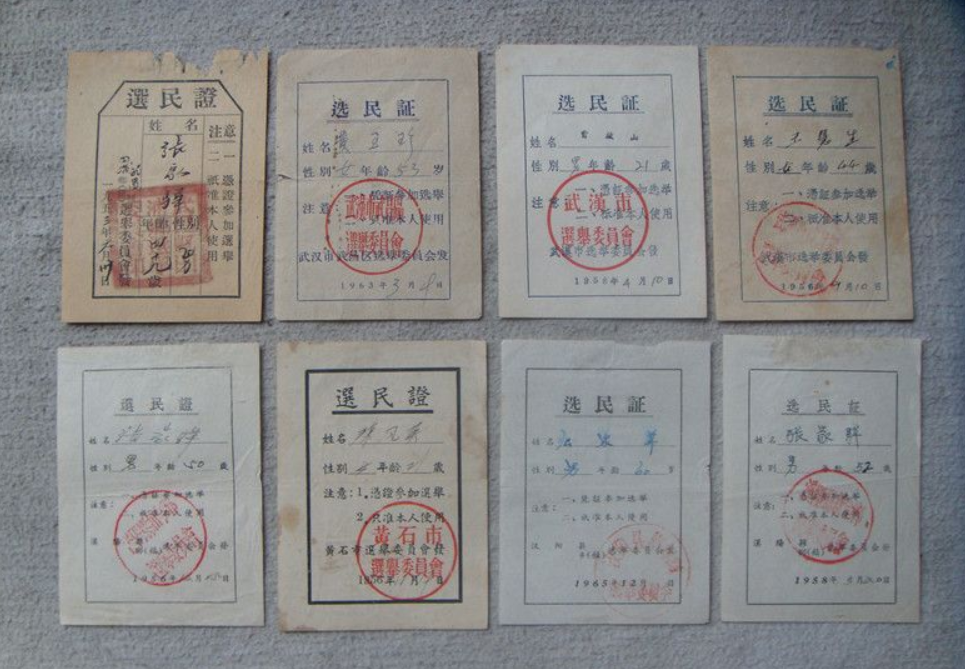
This is a collection of voting cards over the course of many years; the first one is dating back to 1959:
The election system
Candidates are selected as per the painstaking ‘three ups and three downs’ system:
1. The first ‘up’
The committee (electoral college), responsible for the election’s organisation, collects all the candidate nominations, verifies them, and publishes a first basic list.
2. The first ‘down’
The list is handed over to several groups of random citizens (voters) in every location for review.
3. The second ‘up’
The group representatives defend their review before the election committee, then makes an assessment to reduce the number of candidates.
4. The second ‘down’
The final candidate list is announced.
5. and 6. are the elections themselves
Money, influence or marketing can’t buy a candidate into the final candidate list
At village level, there are usually very few Communist Party
candidates-, sometimes none. In many villages the election battle is
between the other, smaller parties and independent candidates.
As per the Carter Center [16] that oversees China’s elections, voter
turnout is about on average 20% higher than in the USA. [17]
The specific issues and challenges associated with the Chinese
elections are detailed in a paper by the Center for Democracy and
Civil Society at Georgetown University Electoral Administrative
Framework for China.[18]
Election ticket with candidate list
This is a 选举票 xuǎnjǔ piào “Election ticket”, the list with the candidates:
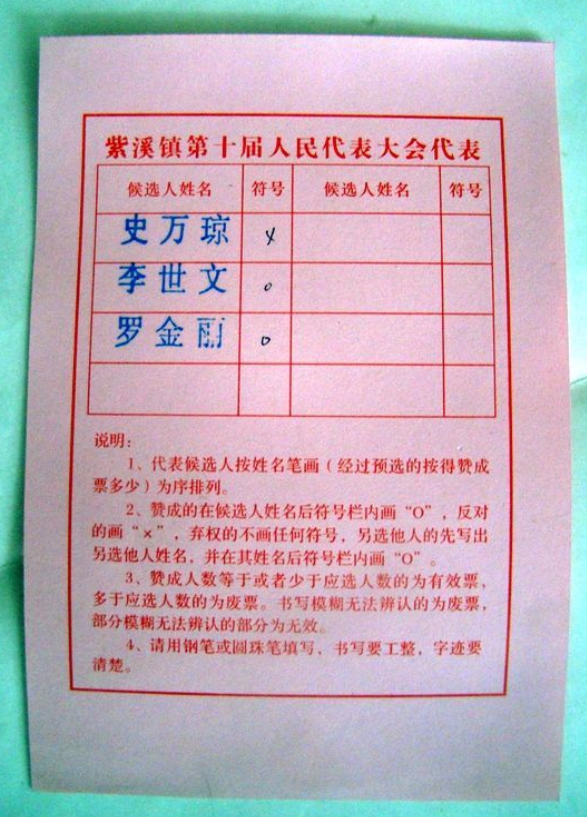
The text reads as follows:
紫溪 镇第 十 届 人民 代 表 大 会代 表
候选人姓名 符号
史万 琼
李 世 文
罗 金 ..
说明:
1、代表候选人按姓名笔画(经过预选的按得赞成 票多少)为序排列。
2、赞成的在候选人姓名后符号栏内画”O”,反对的画”x ” ,弃权的不画任何符号,另选他人的先写出。另选他人姓名,并在其姓名后符号栏内画”O”
3、赞成人数等于或者少于应选人数的为有效票, 多于应选人数的为废票。书写模糊无法辨认的为废票, 部分模糊无法辨认的部分为无效。
4、请用钢笔或固珠笔填写,书写要工整,字迹要清楚。
In English:
Representative of the Tenth People’s Congress of Zixi Town
[Zīxī Xiàn is a county in the Northeast of Jiangxi province]
Candidate’s name symbol
Shi Wanqiong X
Li Shiwen o
Luo Jin.. o
____________ ___
Description:
1. Representative candidates names are written in strokes of their names (those who have been pre-selected are in favour. The candidates are arranged in order.
2. If you are in favour, draw “O” in the symbol column after the candidate’s name. If you oppose him, write “x”. Those who abstain from voting should not draw any symbols. Those who choose other candidates will write the name in the first column. Select another person’s name and draw “O” in the symbol column after their name.
3. Votes are valid if the number of people in favour is equal to or less than the number of candidates. If there are more X or O than the number of candidates, the vote will be annulled. Those whose writing is blurred and unrecognizable are invalid votes, parts that are blurred and unrecognizable are invalid.
4. Please fill in with a fountain pen or a solid bead pen. The writing should be neat and the handwriting should be clear.
Notice the blank spaces where the voters can write additional candidates. Also notice that at the ballot paper here above the voter clearly expressed his disgust for the first candidate.
So — different from our western elections –:
one can vote in favour or against one or all the candidates;
one can vote for more than one candidate;
one can add the name of a person at the election list.
I leave it to you, my dear reader, to judge if the Chinese election system is more democratic than the western system.
If you had never heard of the Chinese elections or the positions of the various political parties in China, why would that be?
The English language Wikipedia entry on this subject “Elections in China” is biased, pityful and pathetic. Change the language from English to Chinese (choose 中文) and then use an on-line translator to translate the Chinese version back to your own language. That’s a bit more objective, although the Chinese version of Wikipedia is usually created by Chinese people in Taiwan (CN) or San Francisco (USA)
Footnotes:
[16] “The Carter Center on elections in China”, The Carter Center, 20.10.2019
https://www.cartercenter.org/peace/china_elections/index.html
Liu Yawei, “China Elections and Governance”, Chinaelections, 20.10.2019
http://www.chinaelections.org/
[17] Godfree Roberts, “Democracy in China” Quora, 20.10.2019
https://www.quora.com/What-percentage-of-Chinese-people-want-democracy/answer/Godfree-Roberts
[18] Prof. Jeff Fischer, Clara Barnett, Shuang Bin, Andrea Murta, Imara Crooms, David Jandura, SharonLazich, Bennett Seftel, Maegen Smith, Trishna Velamoor, and Christina Watts “Electoral Administrative Framework for China”, Georgetown University, Department of Government, 01.12.2011.
http://aceproject.org/regions-en/countries-and-territories/CN/case-studies/local-elections-in-china
[19] “China, election system” 20.10.2019
http://www.jzrd.gov.cn/zhuanti/gz/xxrdhjxj/xjzs/2006/0809/6540.htm



One very democratic difference between the electoral process in the West™ is the “first down” letting a random selection of citizens screen the candidates. In many other countries the candidates are screened by the upper levels of the political parties. Zero input from regular people, the people have to vote for those chosen by the party. In this system the people can reject whoever they wish.
I am curious about the modern workplace environment in China. We in the West™ are very in the dark about Chinese workplace culture. I have sympathy towards instituting meaningful workplace democracy, however your posts about the differences between thw more French workplace culture in French speaking Belgium and the Flemish workplace culture highlights what can happen in dysfunctional attempts to institute workplace democracy. I wonder what methods the Chinese have instituted, whatever methods they are, they seem to be working quite well.
Hello José Ramón
Yes, indeed, the Chinese election system is much more democratic than our western elections.
As for the workplace environment and relations between the workers and top management, I can testify about those conditions, based on my years of experience in Chinese companies in Shanghai, Pudong, Songjiang, Suzhou and Wuxi.
Labor relations and relations are often better, more harmonious, than in Western Europe. This may be due to the much greater sense of responsibility of company management for the well-being of the workers and for Chinese society in general. Chinese companies are embedded in society; they are not money creators; they have a different vision of society than Western companies.
But despite all this, when Chinese workers are still mistreated, they are much more likely to take to the streets for demonstrations than workers in the West.
Thanks for the informative article!
I think it is interesting that voters can explicitly vote for or against candidates, it reminds me of the like / dislike button on YouTube, where the public counts for dislikes are removed. Are the full for / against numbers made public after the election as well? It would be interesting to try and institute this in the US and have the results be public.
I also thought it was cool that most of the local candidates are from independent parties, it seems in the US unfortunately the 2 main parties are the only “viable” options, even at more local levels
Yes, of course, all the full for / against numbers are made public after the election. There is absolute transparency.