Views: 50
How five imperial collapses divided the elite from the ordinary
Frans Vandenbosch 方腾波 17/08/2026
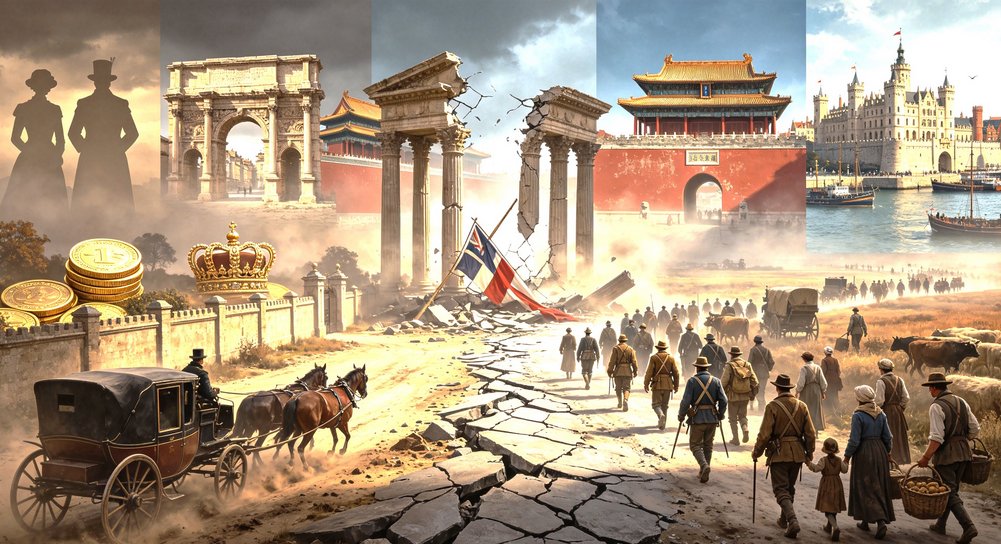
Empires, regimes and cultures rise and fall with the passing of time. It is not only human beings who possess a finite lifespan; civilisations too have to die.[1] They have their allotted seasons of birth, flourishing, decay and eventual dissolution. This essay examines how such transitions in power are internalised by those who live through them, and how drastic shifts in political authority reshape the daily existence of ordinary citizens and elites alike.
With the Western decay in mind, this essay is not an attempt to predict the future. Rather, it seeks to enumerate the possible trajectories that unfold when a centuries-old empire or culture approaches its terminal phase.
In The five stages of western decline; A study in civilisational grief [1] I compared the decay of a power structure to the five stages of human dying as identified by Elisabeth Kübler-Ross.
In The historical cycle of rise and fall of civilisations [2] I elaborated on how China, already now in full economic and political bloom, has prepared itself and devised remarkable strategies to circumvent the traps that have historically accompanied cultural and societal decline.
Five empires, five dramatic deaths.
The collapse of a great empire is rarely a single event; it is a prolonged and often chaotic process that touches every level of society in markedly different ways. For the wealthy, the hereditary noble, the fall might mean the loss of ancient privileges and titles, a gradual retreat into private life. For the merchant or land- or asset owner, it often necessitates a swift recalibration of assets and alliances, often across new borders. For the ordinary people, labourers or peasants, however, the end of empire can bring both acute hardship and unexpected opportunity: the dissolution of old debts or the sudden burden of conscription and inflation.
What follows is a comparative examination of five historic imperial endings, from the ancient Roman world to the twentieth-century dissolution of the British Empire. Each case is viewed through the dual lens of the elite and the commoner, revealing how the same historical moment could be experienced as either a tragedy of status or a dawn of survival.
We have deliberately chosen not to extend this analysis to the ongoing collapse of the American empire; rather, we invite readers to draw their own conclusions, using these five historical examples as a framework for reflection and inspiration.
How different classes experienced the ends of five empires.
1. The Western Roman empire (5th century AD)
- The nobility and the wealthy
As the Western Empire crumbled under barbarian invasions and internal decay, the senatorial aristocracy and wealthy landowners largely retreated from public life. They abandoned the increasingly unsafe cities and fortified their vast rural estates (villae), turning them into self‑sufficient, mini‑fortresses. Many struck deals with invading Germanic chieftains, offering food, gold or allegiance in exchange for protection of their lands and lives. Some aristocrats even entered the new kingdoms as advisors or bishops, preserving their social status and much of their wealth, albeit under new rulers. Their culture remained Roman, but their political horizon narrowed from empire to locality. - Ordinary people
For commoners (peasants, urban plebeians, and small farmers) the collapse was devastating. The breakdown of long‑distance trade and the monetary economy meant that many city dwellers faced starvation. Tax burdens grew heavier as the state tried to finance its defences, pushing smallholders into debt and dependency. To survive, countless free farmers surrendered their land to powerful landlords and became coloni (tied tenants), losing personal freedom and legal rights. In the countryside, they faced raids, plunder, and forced conscription by passing armies. For the majority, the “end” meant a steep decline in living standards, security, and hope for a better future, though some later found a degree of stability under new Germanic customs.
2. The Qing Dynasty (1911–1912)
- The nobility and the wealthy
The Manchu aristocracy and high‑ranking banner families faced a swift fall from power. The abdication of the child‑emperor Puyi in 1912 stripped them of official positions, stipends, and legal privileges. Many wealthy Manchu nobles lost their state‑granted estates and were targeted by anti‑Manchu sentiment. However, the wealthier among them (especially those who had diversified into commerce or owned property in treaty ports like Shanghai) managed to convert their fortunes into modern businesses or real estate, preserving their economic standing. Some collaborated with the new Republican government, while others fled to the foreign concessions for safety. A few became patrons of the new warlord regimes. - Ordinary people
For Han Chinese peasants, urban workers, and soldiers, the end of the Qing brought a mixture of relief and uncertainty. The overthrow of the “alien” dynasty was greeted with nationalist hope but that hope quickly faded as the Republic failed to deliver land reform or stable governance. Ordinary people experienced chaos: local uprisings, banditry and the rise of warlords who taxed and conscripted them mercilessly. In the countryside, many tenant farmers remained trapped under the same landlord class, just with a new flag overhead. Urban artisans and rickshaw pullers faced inflation and unemployment. The fall of the imperial order meant the loss of traditional moral authority, leaving commoners to navigate a fractured society with little state support.
3. The end of the Republican era in China (1949)
- The nobility and the wealthy
By 1949, the “nobility” in the old sense no longer existed, but the wealthy classes (industrialists, bankers, large landowners, and high‑ranking Kuomintang (KMT) officials) faced a decisive rupture. Many fled to Taiwan, Hong Kong, or overseas, taking movable capital and family treasures with them. Those who stayed were subjected to land confiscation, nationalisation of businesses and in many cases, public criticism during the subsequent campaigns. Some wealthy families, particularly those who had connections with the Communists or were willing to collaborate, managed to keep a portion of their assets by “voluntarily” handing over others. Overall, the transition was traumatic: a world of privilege, Western-style luxury and private property was swept away almost overnight. - Ordinary people
For the vast majority of peasants and workers, 1949 was experienced as liberation and redemption. Land reform gave millions of poor peasants access to land for the first time, while urban workers gained labour rights and social protections. The end of civil war also brought a longed‑for peace and reunification, ending years of horrific fighting and foreign humiliation. However, the transition was not without hardship: rapid collectivisation and new state controls disrupted traditional village life and the subsequent decades brought political changes that affected ordinary people deeply. Yet in the immediate moment of 1949, commoners overwhelmingly celebrated the new order as a dawn of justice and national strength.
4. The Habsburg Empire (1918)
- The nobility and the wealthy
The Habsburg aristocracy (the great landowning families e.g., the Schwarzenbergs, Esterházys) had dominated Central European politics for centuries. With the Empire’s collapse after World War I, they lost their titles, parliamentary seats and privileged legal status. The newly independent states (Austria, Hungary, Czechoslovakia, …) passed land‑reform laws that expropriated vast estates, although in practice, compensation was often paid and many nobles retained some manor houses and forests. The wealthiest adapted by marrying into industrialist families or by managing their remaining properties as modern businesses. Psychologically, the end was a profound shock: they had been the pillars of a multi‑ethnic, Catholic dynasty, and now they were reduced to private citizens, often nostalgic but eventually integrating into the new republics. - Ordinary people
For the Empire’s diverse commoners (German‑Austrian workers, Hungarian peasants, Czech tradesmen, Polish miners, and South Slav farmers) the end meant first relief from war’s horrors and food shortages, then a confusing patchwork of new national identities. Many welcomed national self‑determination: Czechs and Poles saw it as long‑awaited freedom, while German‑Austrians felt stranded as a rump state. Ordinary soldiers returned home to find their imperial army gone and their homelands redrawn. Economic devastation was severe: inflation wiped out savings and unemployment was rife. Yet, for many peasants, land reforms broke up large aristocratic estates, giving them ownership, a tangible, positive change that outweighed the loss of the old imperial order.
5. The British Empire (mid‑20th century, especially post‑WWII to 1997)
- The nobility and the wealthy
Britain’s aristocracy and wealthy imperial elites (the landed gentry, colonial governors and City of London financiers) experienced the Empire’s dissolution as a gradual but inexorable loss of prestige and income. The end of the Raj (India, Pakistan, Bangladesh) in 1947 and the rapid decolonisation of Africa in the 1960s meant that many noble families lost their overseas estates, plantations, and administrative sinecures. However, because the process was largely negotiated (rather than violent revolution), many were compensated by the British state or by local governments. They shifted their capital into domestic property, financial services and the burgeoning post‑war welfare state. Socially, they remained influential in the House of Lords and the upper echelons of the City, but their global aura faded. For wealthy British industrialists, decolonisation opened new markets in the Commonwealth, but also brought competition from the US and Japan. - Ordinary people
For the British working class and rural poor, the end of empire was a distant affair. Most were more concerned with post‑war rationing, housing shortages and the creation of the National Health Service than with the Union Jack being lowered in India or Nigeria. However, the empire’s end did affect them materially: the loss of imperial preference and cheap raw materials contributed to economic decline. It also ended conscription for colonial policing. For ordinary people in the colonies (Indians, Africans, Malays, …) the transition was profound. Many experienced it as a release from colonial rule, but also as a time of violent partition (India), civil war (Nigeria), or economic dislocation. Commonwealth immigration to Britain surged, changing the social fabric of British cities and creating new multicultural communities. In sum, ordinary Britons felt the empire’s end less as a crisis and more as a background noise to domestic transformation, while colonial commoners faced a far more immediate and mixed experience of freedom and hardship.
Summary table
| Empire . ending | Nobility, wealthy | Ordinary people |
|---|---|---|
| Roman | Retreated to fortified estates, cut deals with barbarians, kept local power. | Suffered economic collapse, loss of freedom, increased insecurity. |
| Qing dynasty | Lost official privileges, but many converted wealth to commerce; some fled. | Initially hopeful, then mired in warlord chaos, taxation and no land reform. |
| Republican China | Fled or faced confiscation/nationalisation; traumatic loss of status. | Celebrated liberation and land reform, social protections. |
| Habsburg | Lost titles and estates, but often compensated; adapted as private citizens. | Gained national independence and land reform, but suffered inflation and unemployment. |
| British | Lost overseas assets and prestige, but financially cushioned; remained influential at home. | British working class largely indifferent; colonial commoners experienced both liberation and upheaval. |
The wealthy retreat, the ordinary people gain new freedoms
Each imperial end was unique, yet a common thread runs through: the wealthy often found ways to preserve at least some of their capital and influence, while ordinary people bore the brunt of the physical and economic dislocation. But also, in many cases, gained new freedoms and opportunities that the old order had denied them.
Thank you for reading! We’d love to hear your thoughts. Please share your comments here below and join the conversation with our community!
Endnotes
[1] Gerard De Beuckelaer: Ook culturen moeten sterven. Een poging tot begrijpen. 20.12.2018 https://dwarsliggers.eu/index.php?view=article&id=282:nieuwsbrief-kerstessay [3]