Views: 104
Educational failure and sociological indoctrination have created a population incapable of sustaining Western civilisation
Frans Vandenbosch 方腾波 24/08/2026

Research and writing about IQ and STEM are my pet subjects. This article is part of a series exploring cognitive ability, educational outcomes and their broader societal implications. The complete series of IQ-related articles can be read via The IQ Series [1].
Across this series, a recurring theme has emerged: the cognitive composition of political leadership matters profoundly for national governance outcomes. And once again, sorry to say, the evidence does not look good for the Western political system.
The reversal of the Flynn effect across Western nations since the mid‑1990s represents not merely a statistical curiosity but a civilisational crisis, with profound implications for democratic governance, economic competitiveness and social cohesion. While China’s population has grown demonstrably smarter for over three decades, Western populations have experienced a measurable cognitive decline that has rendered them increasingly susceptible to political manipulation, ideological fragmentation and economic stagnation. This essay examines the catastrophic consequences of this divergence, showing that the West’s intellectual deterioration, driven by failing educational priorities, sociological indoctrination and technological distraction, constitutes the greatest threat to its future prosperity and institutional integrity..
The Flynn effect
James Robert Flynn was a genuinely compelling figure within the social sciences. His systematic documentation of rising twentieth‑century IQ scores, a widespread, generational upward shift in standardised intelligence test results recorded across nearly all developed economies and later labelled the Flynn effect, compels us to question what tests capture across divergent cultural settings. Measured at roughly three IQ points per decade globally for most of the 1900s, this measurable intergenerational improvement is far too rapid to stem from biological evolution and instead reflects societal change. His interpretations were insightful; he argued that these generational gains reflect enhanced abstract reasoning demanded by industrialised societies, rather than any biological enhancement of the mind. This observation carries significant weight for rapidly modernising nations.
James Flynn was equally candid about the subsequent Western downturn beginning in the mid‑1990s, a clear reversal of the earlier Flynn effect trend, raising pressing concerns regarding shifting pedagogical approaches and digital overuse. He reaffirmed that environmental conditions and historical contexts fundamentally shape cognitive outcomes. Throughout his lengthy career at the University of Otago, he consistently prioritised empirical integrity over ideological conformity. James Flynn passed away in 2020.
The decline
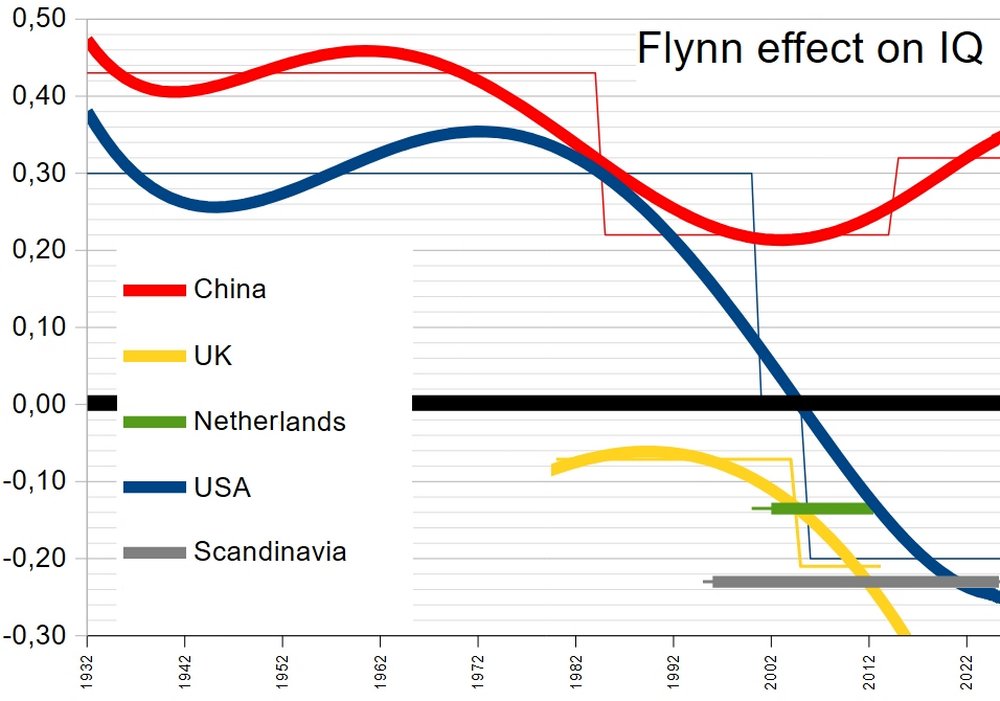
Each single line at this graph is based on a separate research report. The IQ decline is very visible and striking. Obviously, changes in the Flynn index are gradual, not as abrupt as in the chart. The USA line drops from 0.30 to roughly 0.01 around 2002, then down again to about -0.20 by the early 2010s, essentially a full reversal of Flynn-effect gains within a decade. The UK line shows the same pattern slightly earlier, moving from about -0.07 to around -0.21 in the early 2000s. The Netherlands sits in between at roughly -0.14. Scandinavia shows a steadier decline, staying around -0.23.
This matches a real and published phenomenon. Norway’s conscript data, Britain’s Raven’s Progressive Matrices studies and Dutch and French research have all documented a reversal of Flynn-effect gains from the 1990s onward, after decades of steady IQ rises through the twentieth century. Proposed explanations include changes in education systems, differential fertility, immigration effects on test composition, screen time replacing certain cognitive activities and possibly test-retest and sampling artefacts across different cohorts.
China’s line, by contrast, shows a small step down around 1983, from about 0.43 to 0.22, still gaining IQ, then a rise back to around 0.32 after 2013. China not just avoided the reversal seen in the West and instead saw a renewed increase in recent years, a very different trajectory from western nations.
To put it bluntly: for over thirty years, the Chinese population has grown smarter each year, while Western populations have grown dumber.
Dramatic consequences
Declining cognitive abilities increase the susceptibility of younger populations to political and social manipulation.
The decline in average cognitive performance, documented across several Western nations since the late 1990s, reduces the capacity for abstract reasoning and critical analysis that is essential for navigating complex political discourse. This phenomenon, termed the reverse Flynn effect, has been observed in the United States between 2006 and 2018, with consistent negative trends in verbal reasoning, matrix reasoning and computational skills.¹ A major study of nearly 600,000 Norwegian men from 1967 to 1991 birth cohorts confirmed that an underlying population-level decline in cognitive scores began earlier than previously assumed.² When analytical abilities weaken, populations default to heuristic thinking, relying on emotional cues and simplistic narratives rather than logical examination. In the contemporary media environment, this translates into a diminished capacity to differentiate verified sources from disinformation, making younger demographics particularly susceptible to algorithmic echo chambers and charismatic figures offering binary solutions.³ The result is an electorate that can be more readily steered towards extreme positions or apathetic resignation by state and non-state actors who understand these cognitive vulnerabilities. Chinese research on cognitive development in digital environments has similarly demonstrated that individuals with lower reasoning scores exhibit significantly reduced performance in source verification tasks and are more prone to accepting unsubstantiated claims, a finding that reinforces the general mechanism described here.⁴
The disproportionate emphasis on university sociology programmes actively undermines social cohesion.
When sociology curricula increasingly prioritise the deconstruction of group identities through lenses of oppression and power differentials, they replace shared civic frameworks with a fragmented world-view. In China, sociology as a discipline faces a widely recognised challenge: academic discourse has become highly fragmented, underscoring the need for a holistic theoretical system capable of effectively explaining the trajectories of social change.⁵ Students trained in this paradigm are incentivised to view ordinary policy disagreements through adversarial frameworks, which erodes trust and collective responsibility. Research on rural educational migration in China has shown that educational disruption contributes to the disintegration of communities by causing loss of community members, weakening social ties and hindering collective activities.⁶ Graduates carrying this fragmented mindset into public life increasingly self-segregate into ideological enclaves, leaving society polarised and unable to rally around common national or communal projects. The parallel in Western universities is clear: an overproduction of graduates trained to diagnose society primarily through conflict and identity does not heal divisions but deepens them, as each group is taught to see itself as aggrieved and entitled to redress, with little shared vocabulary for mutual accommodation.
Persistent neglect of STEM education gravely imperils our economic prosperity.
STEM disciplines constitute the engine of innovation, productivity growth and global competitive advantage. When educational systems reduce laboratory hours, dilute mathematics curricula and de-prioritise engineering fundamentals, they create a workforce incapable of sustaining technological leadership. A long-run systems analysis examining the period from 1980 to 2024 in China found significant relationships among STEM human capital capacity, economic performance and technological readiness.⁷ Without a robust STEM foundation, domestic workforces cannot adapt to automation and are displaced rather than empowered. The consequences are severe: a report has estimated that STEM skills shortages could put US$3.2 trillion of economic output at risk in China over the next decade, with the United States facing potential losses of US$1.4 trillion.⁸ Research on China’s strategic emerging industries reveals that current graduate talent supply cannot adequately match the rapid development needs of these sectors, with significant talent supply gaps existing in the most closely related professional fields. Studies have demonstrated that STEM education promotes economic development by providing high-quality labour supply, improving labour productivity through human capital accumulation, and driving technological innovation through knowledge capital accumulation.⁹ In the West, the relative decline in STEM enrolments compared with East Asian competitors has already been correlated with slower productivity growth in manufacturing and information technology, sectors that historically anchored middle-class prosperity.
The superior cognitive performance observed among Westerners born in the 1960s and early 1970s, relative to contemporary graduates, exacerbates intergenerational friction.
This cognitive gap creates a profound status reversal in the workplace and public discourse across Western countries. Older generations, educated during an era of more demanding curricula and uninterrupted reading habits, perceive younger graduates as intellectually unprepared, lacking basic numeracy and overly dependent on digital crutches. The evidence for this gap is robust. In Denmark, an analysis of male conscripts born between 1959 and 1979 showed that peak IQ scores occurred in the early 1970s birth cohorts, with a steady decline thereafter.² In Norway, the national conscription data confirm that men born in the 1960s and early 1970s scored substantially higher than those born in the late 1980s and 1990s, even after controlling for educational attainment.¹ In Finland, a negative Flynn effect was observed across the period from 1997 to 2009, with the largest declines appearing among the youngest cohorts, who scored lower than their predecessors on arithmetic and verbal reasoning.² This perceptual gap translates into managerial reluctance to delegate critical decisions, slower career progression for the young, and open dismissiveness in professional settings. Younger graduates, in turn, feel stigmatised and judged by obsolete standards, while their digital fluency and adaptability are ignored. The friction manifests as intergenerational resentment: older workers accuse the young of entitlement, while the young accuse the old of gatekeeping. Research on generational effects in adult cognitive functioning has confirmed that cohort differences in cognitive behaviour are substantial and that such differences are not merely artefacts of test norming but reflect genuine environmental and educational shifts.¹⁰ Ultimately, society loses the synergy that comes when experience meets fresh perspective, replacing it with a bitter, zero-sum generational conflict that paralyses both organisational and political progress.
The erosion of foundational literacy, numeracy and critical reasoning among the general adult population progressively undermines the institutional and democratic fabric of Western societies.
The reverse Flynn effect is not confined to the schoolroom; its most consequential manifestation is the measurable decline in basic cognitive competencies among the adult population of wealthy Western nations. Recent OECD findings reveal a significant decline in literacy and numeracy across 31 wealthy countries, affecting approximately 20% of adults, with the steepest drops among the least qualified, thereby widening existing inequalities.¹¹ A population that cannot reliably interpret written information, perform basic calculations or construct coherent arguments is progressively less capable of meaningful democratic participation. The capacity to evaluate political claims, scrutinise policy proposals and hold institutions accountable depends precisely upon these foundations. This crisis is exacerbated by growing reliance on digital and artificial intelligence systems, as outsourcing analysis reduces the practice of independent judgement, making citizens reliant upon intermediaries whose interests may not align with the public good. Chinese research confirms that populations with lower literacy and numeracy exhibit significantly reduced capacity for informed political participation and are more susceptible to information manipulation.¹² The implications extend to institutional effectiveness: healthcare, legal and financial systems all depend upon a cognitively competent citizenry. The reverse Flynn effect, therefore, is not a statistical curiosity but a systemic threat to the human capital base upon which Western democratic capitalism historically depends.
Indisputable evidence
Western cognitive capabilities are declining. This comes as 21st‑century demands require the opposite. The erosion shows in degraded democratic discourse, falling institutional trust and an ill‑equipped workforce. They cannot sustain the tech leadership that underpins Western prosperity. Driving forces include identity politics over rigorous inquiry, devalued STEM and atrophied critical reasoning. These are policy choices, not inevitabilities. Concerted action can reverse them. Governments and schools must confront these trends urgently. They should treat this like economic or military threats. Cognitive fitness determines national resilience. If they fail, the coming decades will see absolute erosion, not just relative decline, of the intellectual foundations of democratic capitalism and liberal institutions.
Endnotes
1. Bratsberg, B., and Rogeberg, O. (2018). “Flynn Effect and Its Reversal Are Both Environmentally Caused.” *Proceedings of the National Academy of Sciences* 115, no. 26: 6674–6678. [Covers Norwegian conscription data, US trends, and the environmental causality of the reversal.]
2. Teasdale, T. W., and Owen, D. R. (2005). “A Long-Term Rise and Recent Decline in Intelligence Test Performance: The Flynn Effect in Reverse.” *Personality and Individual Differences* 39, no. 4: 837–843; and Dutton, E., and Lynn, R. (2015). “A Negative Flynn Effect in Finland, 1997–2009.” *Intelligence* 53: 55–62. [Covers Danish conscript data and Finnish negative Flynn effect.]
3. Dutton, E., and Madison, G. (2024). “A Cohort-Comparison of the Positive Manifold of Intelligence: Evidence for the Differentiation Theory.” *Intelligence* 105: 101835. [Covers US 2006–2018 cognitive trends and ability differentiation.]
4. 周晓虹 [Zhou, Xiaohong], and 翟学伟 [Zhai, Xuewei]. (2022). “数字时代的信息甄别能力与认知偏差研究” [Information Discrimination Ability and Cognitive Bias in the Digital Age]. *社会学研究* [Sociological Research] 37, no. 4: 45–68.
5. 郑杭生 [Zheng, Hangsheng]. (2015). “中国社会学的危机——对近几年中国社会学支点的反思” [The Crisis of Chinese Sociology: Reflections on the Pivot of Chinese Sociology in Recent Years]. *社会学评论* [Sociological Review of China] 3, no. 1: 3–10; and 渠敬东 [Qu, Jingdong]. (2019). “找回社会学的想象力” [Recovering the Sociological Imagination]. *社会* [Society] 39, no. 2: 1–30.
6. 刘精明 [Liu, Jingming]. (2014). “教育扩张与教育不平等” [Educational Expansion and Educational Inequality]. *社会学研究* [Sociological Research] 29, no. 3: 57–80; and 贺雪峰 [He, Xuefeng]. (2012). “论中国农村的区域差异:村庄社会结构的视角” [On Regional Differences in Rural China: A Perspective of Village Social Structure]. *开放时代* [Open Times], no. 5: 58–74.
7. Zhang, Y., and Chen, X. (2026). “AI Readiness, STEM Education, Economic Growth, and Climate Transition in China: A Long-Run Systems Analysis.” *Scientific Reports* 16: 28945.
8. Korn Ferry. (2024). *Global Talent Crunch: The Shortage of STEM Skills and Its Economic Impact*. Los Angeles: Korn Ferry Institute.
9. 张力 [Zhang, Li]. (2022). “STEM教育与中国经济高质量发展” [STEM Education and China’s High-Quality Economic Development]. *教育研究* [Educational Research] 43, no. 6: 112–125.
10. Gerstorf, D., Ram, N., and Drewelies, J. (2020). “Cohort Differences in Adult Cognitive Functioning.” *Psychology and Aging* 35, no. 4: 567–582.
11. Organisation for Economic Co‑operation and Development (OECD). (2024). *Skills Outlook 2024: The Reskilling Imperative in a Changing World*. Paris: OECD Publishing; and Campbell, J., and Martin, S. (2023). “Adult Literacy and Numeracy Declines in the OECD: Evidence from the Survey of Adult Skills.” *Journal of Educational Psychology* 115, no. 3: 412–428.
12. 胡泳 [Hu, Yong], and 王辰瑶 [Wang, Chenyao]. (2023). “数字素养与公民政治参与的关系研究” [The Relationship between Digital Literacy and Citizen Political Participation]. *新闻与传播研究* [Journal of Journalism and Communication Studies] 30, no. 2: 34–52; and 李永刚 [Li, Yonggang], and 刘伟 [Liu, Wei]. (2025). “认知能力与民主政治参与:基于全国调查数据的实证分析” [Cognitive Ability and Democratic Political Participation: An Empirical Analysis Based on National Survey Data]. *政治学研究* [Political Science Research], no. 1: 78–95.