Views: 44
Political‑party structures and governance in China
Frans Vandenbosch 方腾波 14/09/2026
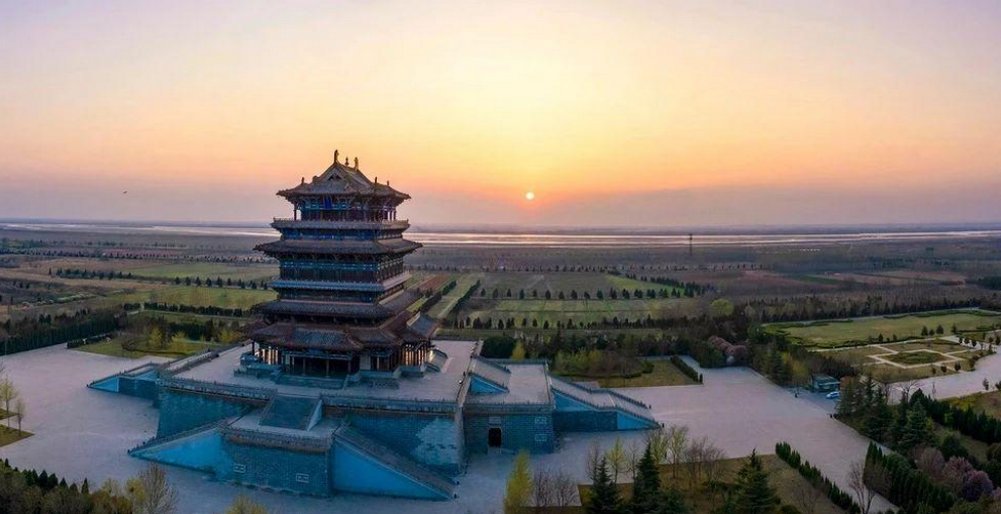
The Yellow River does not read a memorial
In the seventh century, the Tang poet 王之涣 Wáng Zhīhuàn (688–742) stood upon the Stork Tower i [1] overlooking the Yellow River and wrote:
白日依山尽,黄河入海流。
欲穷千里目,更上一层楼。
The white sun sinks behind the mountains;
the Yellow River flows into the sea.
If you would see a thousand li farther,
climb one storey higher.
The final couplet contains a deceptively simple proposition: when the existing vantage point is insufficient, the answer is not to describe what one already sees more eloquently, but to climb higher and see more.
The image has a surprisingly precise political application. For centuries, Chinese government had to confront problems that could not ultimately be settled by rhetoric. An embankment either held or failed. A canal either carried the expected volume or it did not. An irrigation project either produced the intended result or it did not. The official might submit an elegant memorial to the emperor, but the Yellow River was indifferent to the quality of his prose.
The river did not read the memorial. It supplied its own verdict.
This points towards a fundamental distinction in the nature of government. A political system can become highly proficient at managing perceptions: formulating messages, testing public sentiment, adjusting rhetoric and measuring the reaction to political performances. Yet none of these activities necessarily establishes whether a policy has actually worked.
A different conception of government begins elsewhere. Objectives are established, resources allocated, results measured and deviations identified. Policies are then adjusted when reality refuses to conform to the original assumptions.
The distinction is ultimately epistemic. One asks whether the audience has been persuaded. The other asks whether reality has confirmed the proposition.
As Wang Zhihuan understood, when the existing vantage point is inadequate, the solution is simple:
欲穷千里目,更上一层楼。If you would see farther, climb higher.
Chinese politics operates in a wholly different sphere from its Western counterpart.
In China, politics is treated as a serious endeavour; it is not mere theatre. Chinese citizens abhor politicians who resort to bombastic rhetoric in the media. Officials at all levels are assessed and promoted based on performance indicators (KPI’s) The way, China selects its governing elite is a rigorous performance-based system. Read more: How China selects its governing elite [2] Overt self-promotion or excessive media exposure is generally regarded as a weakness. Chinese elections are somewhat different from what’s happening in the West. Read more: Chinese elections [3]
Unlike in the West, China has no majority or opposition parties. All politicians and officials of all parties are dedicated to the well-being of all Chinese people. It was the Communist Party of China itself that, during the early years of the People’s Republic, encouraged the establishment of, and participation by, other smaller parties, aiming to incorporate dissenting perspectives into the governance process.
Membership to the Communist Party of China entails particularly demanding entry requirements. Prospective candidates must engage in intensive study, submit regular reports, defend their theses before local or provincial committees and perform volunteer work in neighbourhood committees. The whole process can take up to two years. Only one in ten candidates survives the harsh process. In summary, the oath they take during the admission ceremony comes down to something like: ‘I will be first to bear the burdens of the Chinese people, and the last to enjoy the pleasures.’
By contrast, the entry requirements for the smaller parties bear a striking resemblance to those of Western service clubs: candidates must secure nominations from two sponsors who know them well, undergo a closed-door assessment by the local party council, and finally swear an oath of loyalty and take part in a ceremonial initiation.
The American duopoly: domestic theatre and bipartisan empire
The contrast between China’s cooperative political structure and the American two-party monopoly could hardly be starker. In the United States, the Democratic and Republican parties have constructed a virtual duopoly that systematically marginalises all third parties. Smaller parties face prohibitive ballot access laws, exclusion from televised debates and campaign finance rules that are deliberately skewed to protect the established order. This entrenched two-party cartel has widened a yawning gulf between itself and ordinary citizens. Voter apathy and distrust are endemic, as millions feel that neither major party represents their genuine interests, only the donors and lobbyists who bankroll their campaigns.
The spectacle of partisan warfare on domestic issues is largely theatre; both parties are conspicuously unison in their support for American military intervention and a hawkish foreign policy. Their bitter squabbles over healthcare or taxation vanish when it comes to defending the defence industry or projecting global power. This carefully choreographed rivalry gives the illusion of choice while preserving the status quo, effectively reducing democracy to a revolving door of establishment insiders. Meanwhile, genuine alternatives are ruthlessly suppressed and the citizenry is left with a binary choice that serves the party machinery far better than the public good.
Political parties in China.
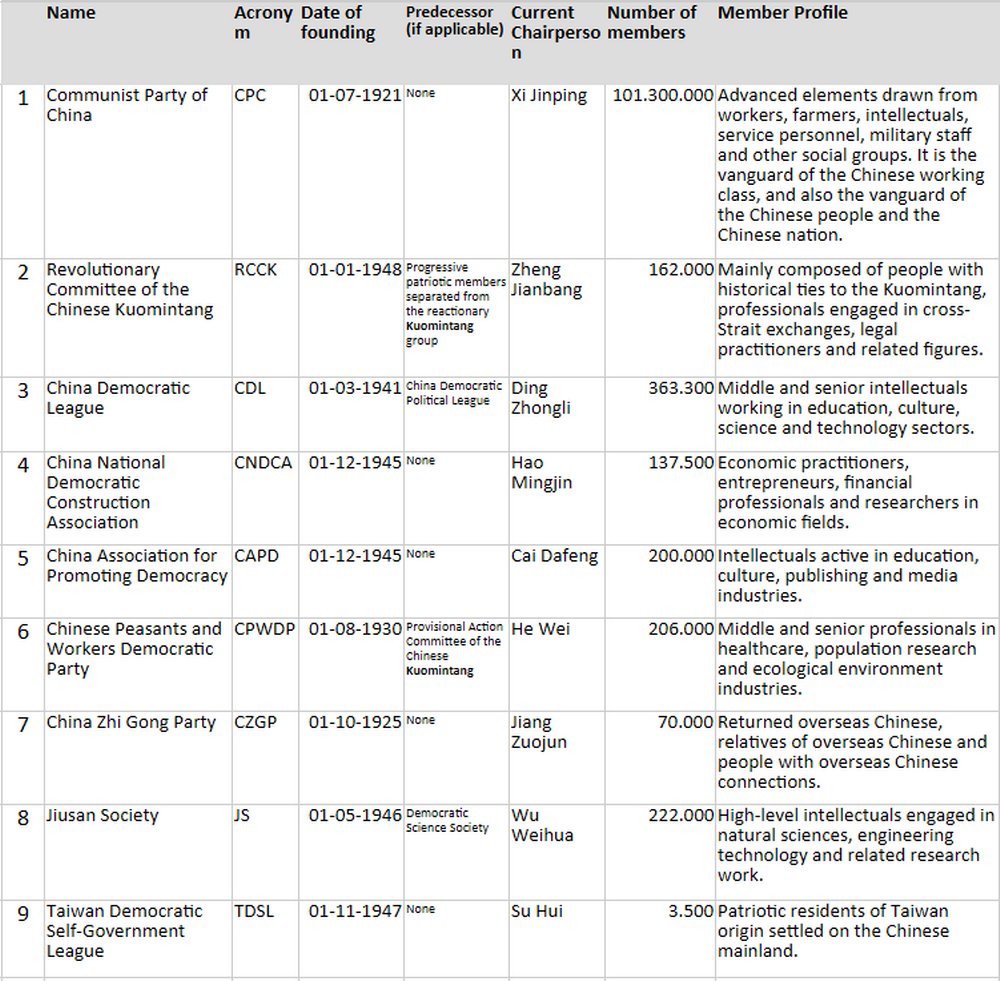
Comments on the political party system table
This table provides a concise and informative snapshot of the multi-party co-operation system. It effectively outlines the political parties within the People’s Republic of China, detailing their foundational dates, successor organisations, current leadership, and reported membership figures.
A salient observation is the stark contrast in membership numbers, with the CPC having a membership exceeding 100 million, dwarfing the combined totals of the other eight parties. This numerically underscores the CPC’s position as the predominant ruling party, whilst the other parties (often referred to as ‘participating parties’) are characterised by their significantly smaller, niche memberships.
The table highlights that the non-CPC parties are not opposition parties in the traditional Westminster sense. Rather, they are defined by their specific constituencies, such as the Revolutionary Committee of the Chinese Kuomintang’s links to historical figures, the China Democratic League’s focus on education and cultural elites, and the China Zhi Gong Party’s representation of returned overseas Chinese. This structure ensures a system of ‘consultative democracy’, where these groups are intended to provide input and oversight within a framework ultimately directed by the CPC.
It is also worth noting the historical evolution of these organisations. Several parties were founded in the 1940s, often in response to the political turmoil of the era. The table notes that some, like the China Democratic League and the Jiusan Society, evolved from earlier iterations, reflecting a developmental process that culminated in their acceptance of the CPC’s leadership following the establishment of the People’s Republic.
Overall, the table serves as a useful reference for understanding the formal architecture of China’s political landscape. It clearly delineates the different entities involved, but equally demonstrates the hierarchical nature of the system, wherein the CPC stands as the core decision-making authority, supported by satellite parties representing specific professional and social strata.
Non CPC party members at top positions:
Huang Runqiu is member of the Jiusan Society. He currently is Minister of the Ministry of Ecology and Environment (full cabinet minister)
Zheng Jianbang, member and chairman of the RCCK (Revolutionary Committee of the Chinese Kuomintang) is vice chairman of the Standing Committee of the National People’s Congress (national deputy state-level leader)
Cai Dafeng, member and chairman of the CAPD (China Association for Promoting Democracy) is another vice chairman of the Standing Committee of the National People’s Congress (national deputy state-level leader)
Zhang Xueqiao, member of the RCCK (Revolutionary Committee of the Chinese Kuomintang) is deputy Prosecutor General of the Supreme People’s Procuratorate (senior national prosecutorial official)
Jiang Zuojun, member and chairman of China CZGP (Zhi Gong Party) is vice chairman of the National Committee of the Chinese People’s Political Consultative Conference (CPPCC, national deputy state-level leader)
Climbing higher: performance‑driven governance versus partisan spectacle
China’s performance‑oriented collaborative governance strongly contrasts with America’s theatrical two‑party duopoly. China’s multi‑party system prioritises practical policy outcomes over rhetorical performance, with strict CPC recruitment and eight democratic parties contributing diverse expertise to state governance. Non‑CPC officials occupy key national positions, proving inclusive participation. Unlike Washington’s partisan show serving special interests, Chinese governance judges policies by real‑world results, echoing the metaphor that the Yellow River cares nothing for fine‑worded official reports.
Thank you for reading! We’d love to hear your thoughts. Please share your comments here below and join the conversation with our readers!
Endnotes
i [4] The Stork Tower is in Puzhou Town, Yongji City, Shanxi province, China